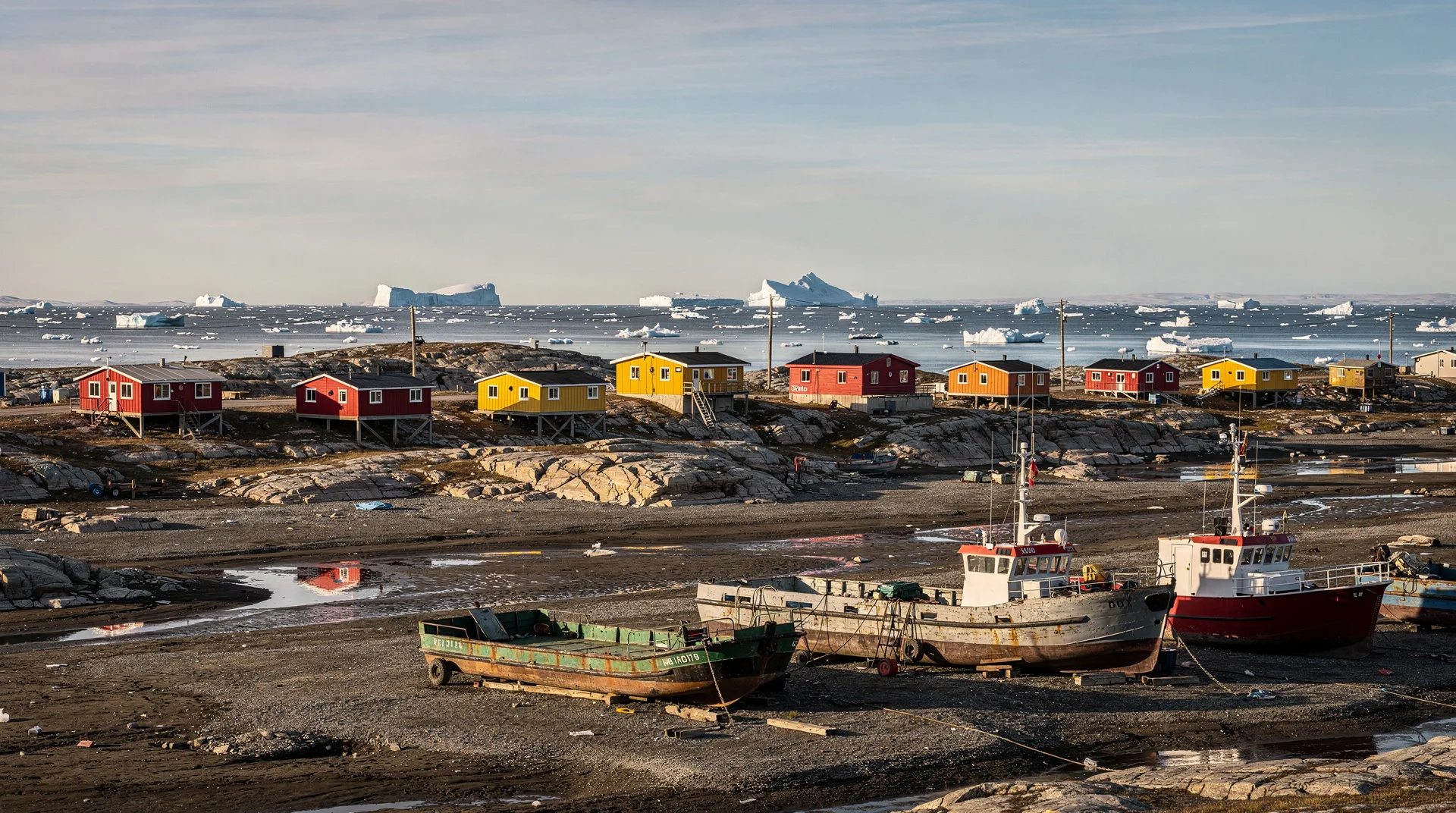
Quick facts
- Population
- ~8,000
- Location
- 63.7°N on Frobisher Bay, Baffin Island
- Getting there
- Flights from Ottawa, Montreal, Winnipeg
- Best time
- June–August; March–April for sea ice
- Days needed
- 3-5 days
| At a glance | |
|---|---|
| Where | Frobisher Bay, southern Baffin Island, Nunavut, 63.7°N |
| Cost | Roughly CAD 3,500-5,500 per person for a 5-day trip including flights, hotel, and meals |
| Time needed | 2-3 days for the city itself; more if connecting onward into Baffin Island |
| Getting there | Flights from Ottawa (most direct), with less frequent connections from Montreal, Winnipeg, Yellowknife |
| Best time | June-August for wildlife and daylight; March-April for stable sea ice and late aurora |
Iqaluit sits at the head of Frobisher Bay on the south shore of Baffin Island, at 63.7° North — a community of approximately 8,000 people that serves as the capital of Nunavut, Canada’s newest and largest territory. The name means “Place of Many Fish” in Inuktitut, a reference to the Arctic char that move through Frobisher Bay in significant numbers.
The community’s history stretches from ancient Dorset and Thule Inuit occupation through the arrival of Martin Frobisher’s expeditions in the 1570s (he was searching for the Northwest Passage, took samples of rock he believed contained gold, and was wrong about both the route and the ore), through a brief American military base during the Second World War, through the construction of the DEW Line radar stations that brought the first significant non-Indigenous population, to the establishment of Nunavut on April 1, 1999.
Iqaluit is simultaneously the most accessible community in Nunavut and the least representatively remote. The city has an airport, hotels, restaurants, a hospital, a university campus (Nunavut Arctic College), a legislative assembly, a grocery store with produce flown in from the south, and the kind of administrative infrastructure expected of a territorial capital. For a visitor arriving from Ottawa — the most direct and common flight route — the first days in Iqaluit function as orientation: to Arctic light, to Inuit cultural presence, to the cost of northern living, and to the sheer scale of the territory beyond the city.
Iqaluit as a window into Inuit life
The city’s approximately 85% Inuit population makes it qualitatively different from any other Canadian capital. Walking through downtown Iqaluit, you hear Inuktitut in the street. The Legislative Assembly conducts business in Inuktitut alongside English and French; the debates are interpreted simultaneously. The Nunatta Sunakkutaangit Museum on the Frobisher Bay waterfront houses one of the finest collections of Inuit cultural objects in Nunavut — tools, clothing, art, and artefacts spanning centuries of Arctic cultural life — with curation that emphasises Inuit perspectives rather than southern anthropological frameworks.
Cultural events and community gatherings are the best windows into contemporary Inuit life. The Toonik Tyme festival (April) celebrates the return of the Arctic spring with community games, drum dancing, seal-skinning demonstrations, and igloo-building competitions. The Alianait Arts Festival (June) brings together Indigenous and northern artists from across the Arctic in performance and visual arts events. If your timing aligns with either, make the most of it.
What to do in Iqaluit
Nunatta Sunakkutaangit Museum
The city’s main museum is in a former Hudson’s Bay Company warehouse on the waterfront. The collection spans ancient Dorset culture artefacts (the pre-Thule people whose distinctive tools and carvings are among the most striking objects in Arctic archaeology), through Thule period hunting equipment and clothing, to 20th-century objects documenting the profound changes brought by contact with southern Canada. The art collection includes work by major Nunavut Inuit artists.
The museum is small by southern standards and large by Nunavut standards. Allow 1–2 hours; the depth of the collection relative to its modest footprint rewards careful attention.
Sylvia Grinnell Territorial Park
On the city’s western edge, the Sylvia Grinnell River flows through a territorial park accessible on foot from the residential neighbourhoods. The park offers hiking on tundra, excellent Arctic char fishing (licence required), and the experience of being on open subarctic terrain within walking distance of a city. The tidal flats at the river’s mouth support shorebirds during migration; the upland tundra provides bog labrador tea, crowberries, and bearberries depending on the season.
In July, the Arctic char run through the Sylvia Grinnell is one of the most accessible char fishing opportunities in the eastern Arctic — local Inuit fish the river with traditional methods alongside sport fishing visitors.
Frobisher Bay and coastal walking
The tidal mudflats of Frobisher Bay at low tide, extending 10–15 kilometres seaward from the city, represent an Arctic coastal environment of considerable character. Ringed seals haul out on the ice in spring; Arctic terns nest on bay islands; and the bay itself — with its dramatic tidal range and the mountains of Baffin Island rising behind the city — provides the kind of Arctic coastal landscape that Iqaluit’s urban function can obscure.
Local guides run boat tours on Frobisher Bay in summer that access sea ice remnants in June, beluga whale habitat, and the bay’s outer reaches where seabird colonies are active.
Inuit art galleries and purchases
Iqaluit has several galleries and artist co-operatives selling Inuit art — printmaking, stone sculpture, jewellery, and textile arts produced by artists across Nunavut. Buying directly from galleries in the capital ensures the work is genuine and that proceeds return to Inuit artists. The Uqqurmiut Centre for Arts and Crafts in Pangnirtung (accessible by charter flight) is one of the most respected Nunavut art centres, but Iqaluit galleries can arrange purchase and shipping for buyers.
Inuit sculpture in soapstone (steatite) — the characteristic dark-green or grey stone of the eastern Arctic — is the most commonly available medium. Prices range from a few hundred dollars for small pieces to tens of thousands for museum-quality works by established artists. Authentication certificates from Cape Dorset Fine Arts or the Inuit Art Foundation provide provenance.
Cultural and community immersion
The most rewarding Iqaluit experiences often arise from simple presence and openness. The local radio station (CKIQ) broadcasts in Inuktitut. The city’s community events are not generally designed for tourists — they are real community gatherings to which visitors are often welcome if they approach respectfully. Asking at the visitor centre about community events during your stay consistently yields better results than following a pre-set itinerary.
Browse Canada Arctic and Nunavut expedition experiencesIqaluit as a gateway
Most visitors to Nunavut beyond Iqaluit connect through the city. Charter flights to the wider Baffin Island communities — Pangnirtung (for Auyuittuq National Park), Cape Dorset/Kinngait (for art), Pond Inlet (for narwhal and sea ice), and Clyde River (for sea kayaking and wildlife) — all route through Iqaluit or connect through the city’s airport.
The Baffin Island guide covers the island’s communities and wilderness in detail. For most itineraries, Iqaluit should receive 2–3 days for the city itself, with onward travel to the specific Baffin destination or park you’ve arranged.
Practical realities: cost and access
Flights: Canadian North and Air Inuit operate scheduled service between Ottawa and Iqaluit (approximately 3 hours) multiple times per week. Fares typically run CAD 800–1,600 return depending on season and advance purchase. Occasional connections from Montreal, Winnipeg, and Yellowknife exist but are less frequent. Book 6–8 weeks in advance for summer; flexibility on dates significantly affects price.
Accommodation: Three main hotels — the Frobisher Inn (the largest, centrally located, reliable), the Discovery Lodge Hotel (newer, comfortable), and the Navigator Inn (smaller, more basic). Rates run CAD 220–380 per night. All accommodation books out quickly in July and August; reserve 2–3 months in advance.
Food costs: Groceries in Iqaluit are expensive — the additional cost of flying food north is passed directly to consumers. A simple grocery run costs 2–3x equivalent southern prices. Restaurant meals run CAD 30–60 for a main course. Budget CAD 150–200/person/day for accommodation and food.
Total trip cost: A 5-day Iqaluit visit, including return flights from Ottawa, accommodation, and meals, realistically costs CAD 3,500–5,500 per person. This is before adding any guided activities or onward travel within Nunavut.
Extending your trip into Baffin Island
Because nearly all Baffin Island travel routes through Iqaluit’s airport, most first-time Nunavut visitors treat the city as the base for a longer trip rather than the whole itinerary. Onward charter flights connect to Pangnirtung for access to Auyuittuq National Park, a genuinely wild fjord-and-icefield park that requires far more planning and gear than the city itself. The broader Baffin Island guide lays out the other community options — Cape Dorset/Kinngait for Inuit art, Pond Inlet for narwhal and sea ice — and how each connects through Iqaluit.
Travellers weighing Iqaluit against Canada’s other Arctic gateway, Inuvik, should know the two are quite different in character: Inuvik is road-accessible via the Dempster Highway and sits in the western Arctic’s Mackenzie Delta, while Iqaluit is fly-in only and anchors the eastern Arctic’s Inuit cultural and administrative centre. Neither is a substitute for the other — they open onto different parts of the North.
Planning around Iqaluit
Iqaluit is easiest to plan when you treat it as the first chapter of a wider northern trip. The Nunavut overview places the capital within the territory as a whole, and it helps to read it before deciding how much time to give the city versus the communities beyond it.
If wildlife is what draws you north, the narwhal viewing guide for Nunavut and the floe edge tours guide describe the experiences that most travellers pair with a stay in the capital. Both involve onward travel, so decide early whether they belong in your itinerary.
Light shapes the whole visit. The midnight sun guide explains what long Arctic days feel like, while the best time to see the aurora in the North helps you choose between a summer trip and a shoulder-season one. Pack accordingly: the packing list is a useful starting point, adjusted for northern conditions.
To approach the cultural side of the trip with care, the Indigenous tourism overview offers context on respectful, community-led travel across Canada. Beside the city, polar bears and other large animals are part of northern life, so the wildlife safety guide is worth reading before any walk onto the tundra. For another remote northern comparison, the Dempster Highway guide shows a very different, road-based way of reaching the Arctic. If you want to add a western northern stop, you can also book guided tours in Yukon.
When to visit Iqaluit
March–April: Late aurora season, sea ice is stable, and community events like Toonik Tyme happen. Temperatures are cold (-25 to -15°C) but manageable with proper clothing. The increasing daylight and the spring equinox aurora activity make this a compelling shoulder season.
June: The longest light and the beginning of Arctic summer. The bay opens from ice; boat tours become possible. Alianait Festival in mid-June. Weather is cool and unpredictable; mosquitoes begin in earnest.
July–August: Peak visitor season. Wildlife is most active, hiking is viable, the bay is open for boat tours. Warmest temperatures (10–18°C). Accommodation books out fastest. Midnight sun into early July.
September: Shoulder season with good light, decreasing mosquitoes, and the return of the aurora. Bay is still open for boat tours. Weather is transitioning — cold air masses arrive with increasing frequency.
Frequently asked questions about Iqaluit: Nunavut’s Capital & Gateway to Baffin
Is Iqaluit safe to visit independently? Yes — Iqaluit is the most accessible and manageable community in Nunavut for independent travel. The city has functional tourism infrastructure, a visitor centre, and enough hotels and restaurants that you don’t need a packaged tour. Beyond the city, independent travel in Nunavut requires significant wilderness experience.
Can I see the aurora from Iqaluit? Yes, from late August through April, aurora viewing is possible from Iqaluit. The city has modest light pollution; walking 10–15 minutes from the city centre improves viewing conditions. The darkness above the tundra surrounding the city is genuine — no light pollution in any direction beyond the town’s footprint.
What wildlife can I expect around Iqaluit? Arctic hares (often in groups of dozens), Arctic foxes, ringed seals in the bay, and seabirds throughout summer. Caribou visit the city’s outskirts regularly. Polar bears are occasionally sighted near the community; locals and the RCMP monitor bear activity.
What should I bring to Iqaluit? In summer: lightweight waterproof jacket, insulating layer, sturdy waterproof boots (the terrain is wet tundra), mosquito repellent and head net, and sun protection (UV is intense at this latitude). In winter: insulated parka to -40°C rating, insulated boots to -40°C, wool or synthetic base layers, mitts (not gloves), and neck gaiter or balaclava.
Can I visit Auyuittuq National Park from Iqaluit as a day trip? No. Auyuittuq is reached via a charter flight to Pangnirtung followed by a boat or snowmobile transfer to the park boundary, and any real visit requires backcountry experience and multi-day planning. Treat it as a separate, significant trip extension rather than a side trip from the city.