Quick facts
- Distance from Moncton
- 38 km southeast
- Best time
- July and August
- Tidal range
- Up to 16 metres
- Days needed
- Half to full day
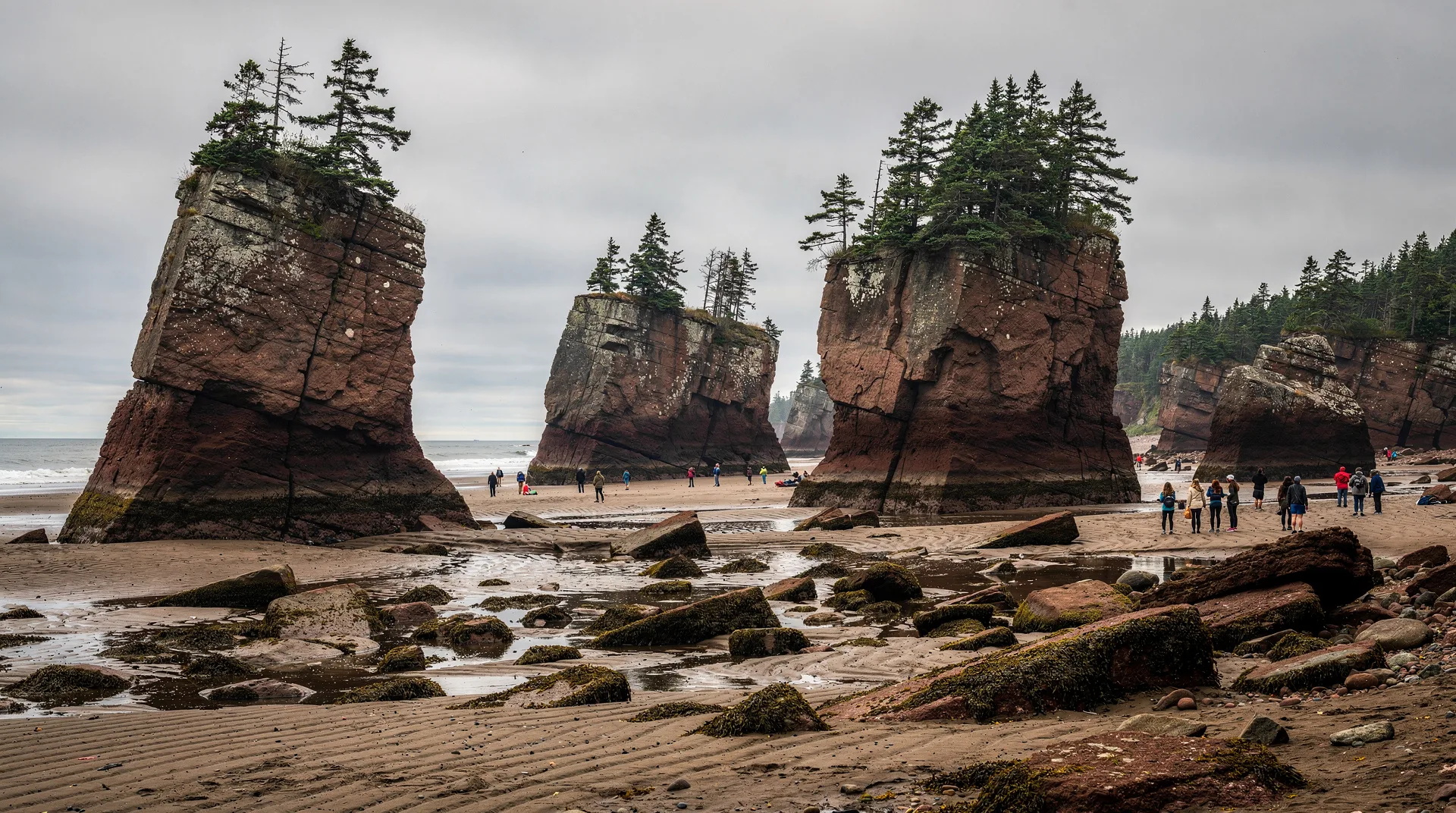
At low tide, you can walk on the ocean floor of the Bay of Fundy. The thought alone is remarkable. At Hopewell Rocks Provincial Park, 38 kilometres southeast of Moncton, the Bay of Fundy’s extraordinary tidal range — up to 16 metres, the highest in the world — retreats twice daily to expose a landscape of sculpted red sandstone pillars, arches, and caves that sit several storeys below the high-water mark. The rock formations — called “flowerpots” for their widening tops, where weathered ledges support soil and wind-bent spruce trees — are the most dramatic expression of what the world’s largest tidal range creates over millions of years of daily sculpting.
| At a glance | |
|---|---|
| Where | Hopewell Cape, ~38 km southeast of Moncton, New Brunswick |
| Cost | Provincial park admission charged (around CAD 15-20 per adult); kayak tours ticketed separately |
| Time needed | Half day for the beach walk and trails; a full day to catch both low and high tide |
| Getting there | Self-drive from Moncton is the practical option — no public transit to the park |
| Best time | July-August for full operations; June and September for fewer crowds |
Then the tide returns. Over the course of approximately six hours, the same ocean floor you walked fills to a depth of 12-16 metres. The flowerpot pillars become sea stacks, the caves become submerged alcoves, and the beach where children were playing becomes the bottom of the bay. Nothing about this is metaphorical or approximate — it is one of the most viscerally impressive tidal experiences on the planet.
Hopewell Rocks is the single most visited natural attraction in New Brunswick, and it earns that status straightforwardly. Timing your visit around the tidal cycle — ideally arriving at or just after low tide to walk the beach, then staying or returning for the high-tide transformation — converts what could be a simple sightseeing stop into a half-day experience that is genuinely difficult to forget.
The tidal science behind Hopewell Rocks
The Bay of Fundy is a roughly funnel-shaped body of water approximately 270 kilometres long that narrows and shallows as it extends northeast from the Gulf of Maine. The shape of the bay creates a resonance effect with the natural oscillation of the ocean’s tidal energy — the water effectively sloshes back and forth in a rhythm that matches the tidal forcing period of approximately 12.4 hours. This resonance amplifies the tidal range far beyond what it would be in an open-ocean setting.
The result is a tidal range that reaches 16 metres at the head of the bay (Burntcoat Head on the Nova Scotia side holds the world record for highest verified tidal range) and averages 12-14 metres at Hopewell Rocks. For comparison, the average tidal range in Halifax is 1.5 metres, and in most of the open Pacific coast it is under 2 metres.
The flowerpot formations at Hopewell Rocks have been carved by this tidal action over approximately 10,000 years — the period since the bay reached approximately its current configuration following the end of the last ice age. The soft red sandstone erodes more quickly at the waterline (where tidal action is greatest) than at the top, producing the characteristic narrow bases and wider, vegetation-capped tops.
Walking on the ocean floor
The ocean floor walk at Hopewell Rocks is accessible for approximately 2-3 hours on either side of low tide — a window of perhaps five to six hours during which the beach between the flowerpot formations is exposed and walkable. At low tide, you can walk among the base of the formations, enter the sea caves, and look up at the rock towers from below. At high tide, the water stands 12 metres or more above where you were standing.
Timing is critical. The park posts daily low-tide times and opens the beach access stairs accordingly. The tides advance by approximately 50 minutes each day. Two low tides occur approximately every 24 hours and 50 minutes. The park website and on-site signage provide current day predictions.
The most dramatic tidal differences occur around new and full moon (spring tides), when the gravitational alignment of sun and moon produces maximum tidal range. These days — which occur approximately every two weeks — produce the most extreme beach exposure at low tide and the most dramatic tidal speed during the rising water.
The stairs to the ocean floor are numbered and descend through the cliff to the beach level. The walk along the base is on exposed bedrock, gravel, and sand — solid and stable in dry conditions but slippery when wet. Wear shoes with grip. The cave interiors can be entered at low tide; the largest caves at Hopewell Rocks extend 10-15 metres into the cliff.
Browse Bay of Fundy and New Brunswick nature tour experiencesHigh-tide kayaking
At high tide, the same formations that were accessible on foot become sea stacks towering above deep bay water. Kayak tours operate around and between the flowerpot pillars during the high-tide window — a fundamentally different experience from the beach walk, with the scale of the formations visible from water level and the geology of the cliff face accessible in a way that is not possible from shore.
The park operates guided kayak tours in partnership with outfitters, with departures timed for the high-tide window. Reservations are essential in summer — these tours are consistently popular and fill early. No kayaking experience is required for the guided tours, which take place in stable sea kayaks with trained guides. If you want to compare other options, you can also check guided tours in New Brunswick before you book.
Kayaking among the Hopewell Rocks formations at high tide, with the spruce trees on the tops of the flowerpots only a few metres above the water, is an experience qualitatively different from anything else in Atlantic Canada.
The provincial park facilities and trails
Hopewell Rocks is a well-developed provincial park with a large visitor centre, café, gift shop, and well-maintained facilities. The visitor centre contains excellent interpretation of the Bay of Fundy tidal system, the geological history of the formations, and the ecology of the tidal zone.
Above the cliff, a series of walking trails (3-5 kilometres total, relatively flat) provides views over the bay and access to additional viewpoints on the formations from the top of the cliff. The main trail connects the visitor centre to the various staircase access points. The Beach Trail reaches the most concentrated section of the formations.
A large parking area and shuttle system operates in peak summer — the park can receive several thousand visitors on busy summer days, and the shuttle from the outer parking area to the visitor centre reduces congestion.
Admission to the provincial park is charged. It includes access to the beach (during low-tide windows), the cliff trails, and the visitor centre. Kayak tours are separately ticketed.
Food and practical information
The park café serves basic food — sandwiches, soups, and snacks. For a proper meal, the nearby community of Hopewell Cape has a few options, and Moncton (38 kilometres) has the full range of restaurants. Planning to arrive at Hopewell Rocks for low tide (whenever that falls) and eating in Moncton before or after is the practical approach for most visitors.
What to bring: Comfortable walking shoes with grip, a layer for wind (the Bay of Fundy can be cold even in summer), sunscreen for the exposed beach, and a camera with a wide-angle capability for the beach-level views of the formations.
Accessibility: The cliff trail is stroller and wheelchair accessible. The stairs to the ocean floor are steep and not accessible to wheelchairs or those with limited mobility. The beach surface is uneven.
When to visit Hopewell Rocks
July and August are peak season — full kayak tour operations, maximum staffing, and the best weather. The park is busy; arrive early (by 8am at low tide) to minimize crowds on the beach.
June offers the same experience with fewer crowds and no sacrifice in quality.
September is excellent — the summer crowds have thinned, the weather is typically still pleasant, and the fall light on the red sandstone is beautiful.
Spring tides: Regardless of the month, the most dramatic visit coincides with spring tides around new or full moon. The Bay of Fundy Tidal Information website and the park’s website both post spring tide calendars.
Winter: The park is closed from approximately November to May. The exposed beach is inaccessible and dangerous in winter conditions.
Pairing Hopewell Rocks with the rest of the Bay of Fundy
Hopewell Rocks is rarely a standalone trip — most visitors combine it with other Fundy tidal experiences. The Fundy tidal bore rafting near Moncton lets you ride the incoming tide itself rather than just watch its effects on the shore, a genuinely different (and wetter) way to feel the scale of the tidal range.
Fundy National Park, roughly an hour southwest, adds forested coastal hiking and its own tidal beach access with a Parks Canada pass. Travellers building a longer Atlantic Canada loop often pair Hopewell Rocks with the Atlantic Canada 7-day itinerary or a dedicated Fundy loop 7-day itinerary, both of which sequence the tidal stops so you are not chasing tide tables across the whole province.
For travellers arriving from Nova Scotia, note the driving distance and the tidal science are connected: the same funnel effect that produces Hopewell Rocks’ 12-16 metre range is responsible for the world-record tides recorded further along the bay. Understanding the Bay of Fundy guide’s explanation of the resonance effect makes the on-site interpretation at the visitor centre land better.
Related destinations
Moncton is 38 kilometres northwest — the practical base for Hopewell Rocks, with a full range of accommodation, restaurants, and transport connections. Shediac is 60 kilometres northeast of Hopewell Rocks — the lobster capital and beach destination on the Northumberland Strait. Saint John, NB is 100 kilometres southwest — the Bay of Fundy’s largest city. The Bay of Fundy guide covers the tidal system at the heart of this experience.
Frequently asked questions about Hopewell Rocks
When is the best time to visit Hopewell Rocks?
The optimal visit combines low tide (for the ocean floor walk) and high tide (for the kayak tour or the cliff overlook perspective) — which means either spending most of a day at the park or visiting twice (once at low tide, once at high tide on a return trip). The single most dramatic version is a spring tide day at low tide, when the tidal range is at its maximum.
Can you walk to the Hopewell Rocks formations?
Yes, via stairs from the cliff top that are open during the low-tide window (approximately 2-3 hours before and after low tide). The beach is accessible on foot during this period. The stairs close as water levels rise.
Is Hopewell Rocks suitable for children?
Yes — children are often more delighted by the ocean floor experience than adults. The cave exploration, the scale of the formations viewed from below, and the novelty of walking where the ocean will be are all highly child-engaging. Younger children should be supervised carefully on the rocky beach surface.
How long should you spend at Hopewell Rocks?
A minimum of two hours to walk the beach at low tide, see the main formations, and visit the visitor centre. A half day allows the beach walk, the cliff trails, and a kayak tour at high tide. A full day is only warranted if you are timing the visit for both tidal extremes.
Do you need to book the kayak tours in advance?
Yes, strongly. The kayak tours operate in limited group sizes and fill early in peak season. Book online through the park at least a few days in advance; in July and August, book as far ahead as possible.
How far is Hopewell Rocks from Fundy National Park?
Roughly an hour’s drive southwest along the coast. Many visitors combine the two in a single day trip from Moncton, or as consecutive stops on a longer Atlantic Canada loop, since both are built around the same Bay of Fundy tidal system.
Is Hopewell Rocks worth visiting if you can only see it at high tide?
Yes, though the experience is different — at high tide the flowerpot formations stand as sea stacks and the only way to get close to them is by kayak tour or the cliff-top overlook trails. It is a legitimate visit, but the ocean-floor walk is the signature experience, so time your trip around low tide if you can choose.