Quick facts
- Area
- 906 km² in two blocks
- Established
- 1981 (expanded 2001)
- Designation
- Dark Sky Preserve
- Best time
- Mid-May to October
| At a glance | |
|---|---|
| Where | Southwest Saskatchewan, near the Montana border |
| Cost | No park entry fee at the gate, but a valid Parks Canada pass is required; camping around CAD 15-28/night |
| Time needed | 2-3 days, longer for serious birders and stargazers |
| Getting there | Self-drive only; around 3.5-4 hours from Regina or Saskatoon |
| Best time | Mid-May to mid-June for wildlife and wildflowers, or September for cool weather |
Grasslands National Park preserves some of the last remaining intact mixed-grass prairie in North America — an ecosystem that once covered vast areas of the continent and has been 70% destroyed by agriculture. The park sits in the deep southwest of Saskatchewan, a two-hour drive south of the Trans-Canada Highway, in country so sparsely populated that the drive in feels like entering a different Canada.
It is one of the best places anywhere in North America to experience prairie at genuine scale: free-ranging plains bison, black-tailed prairie dog colonies, burrowing owls, badlands scoured by erosion, and night skies so dark that the Milky Way casts visible shadows. The Canadian park system contains nothing else remotely like it.
The landscape and what it preserves
The park exists in two separate blocks — the West Block, centred on the Frenchman River valley near Val Marie, and the East Block, centred on the Killdeer badlands near Coronach. The two blocks are roughly 100 kilometres apart and preserve complementary landscapes: the West is classic rolling grassland with the river valley cutting through; the East is more dramatic with sculpted badlands and fossil-rich formations.
Mixed-grass prairie — dominated by species like needle grass, wheatgrass, and blue grama — is the ecological heart of the park. This grassland evolved with large grazing animals (bison, pronghorn) and fire, and the park’s management increasingly seeks to restore both through controlled burns and the reintroduced bison herd.
The park sits at the southern edge of Saskatchewan, along the Montana border. Distances are large and settlements are few. Val Marie (population 130) is the main gateway for the West Block; Coronach (population 700) serves the East Block.
West Block: the Frenchman River Valley
The West Block is the most-visited portion of the park and offers the best developed visitor experience.
Ecotour Drive
A 20-kilometre gravel loop road from the park’s southern entrance near Val Marie. The drive passes prairie dog colonies, typical bison habitat, and several short trail access points. Allow 2–3 hours to drive slowly and stop at interpretive points.
70 Mile Butte
An easy 5-kilometre loop hike climbing a prominent butte for panoramic prairie views. One of the park’s signature trails. The view from the top on a clear day stretches to the horizon in every direction — a rare experience of genuinely unbroken prairie.
Prairie dog towns
Black-tailed prairie dogs are a keystone species in the park. Several large colonies exist in accessible locations. Sitting quietly at a prairie dog town for an hour produces extraordinary wildlife viewing: the animals return to normal activity around stationary humans, barking alarm calls, carrying grass, running between burrow entrances.
The prairie dogs support a suite of predator and commensal species — burrowing owls nest in abandoned burrows, ferruginous hawks hunt from the air, rattlesnakes use the burrows, and (historically, and increasingly again) black-footed ferrets have been reintroduced to prey on them.
Bison viewing
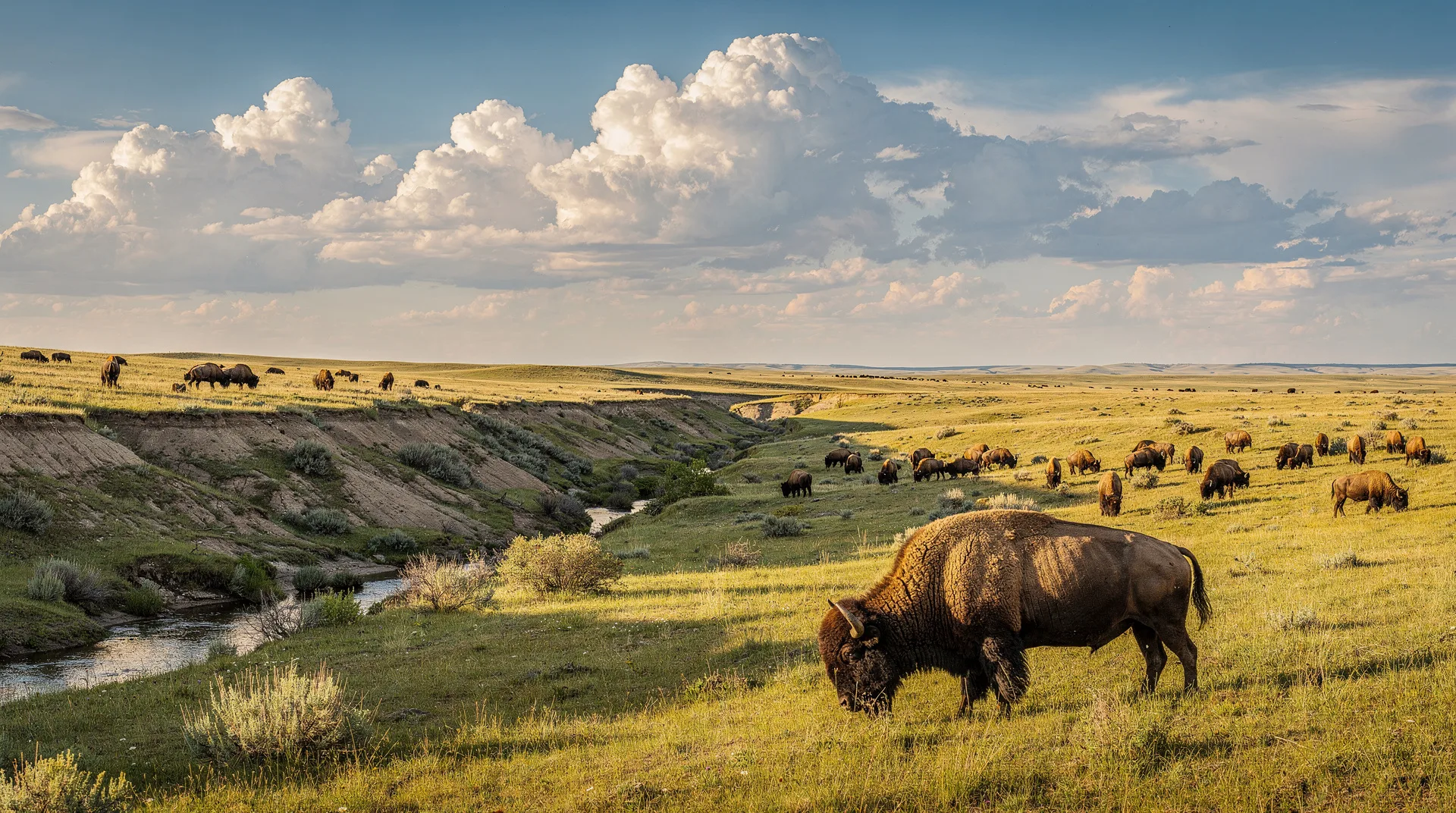
The West Block supports a free-ranging plains bison herd reintroduced in 2005 from Elk Island National Park. The herd now numbers several hundred. Bison are often visible from the Ecotour Road but are not guaranteed — the herd moves over a large area. Ask at the visitor centre for recent sightings.
Keep 100 metres from bison when viewing. They are wild, large, and can run at 50 km/h.
Frenchman River valley
Short hikes down to the river from the Ecotour Road reveal the riparian zone — cottonwoods, cattails, and associated wildlife. Beaver are occasional; deer are common in the evenings.
East Block: the Killdeer Badlands
The East Block offers a more dramatic landscape. The Killdeer Badlands — eroded sedimentary formations exposed by the Frenchman River’s ancient predecessor — contain fossil beds including dinosaur remains from the Cretaceous.
Rock Creek Campground. The main East Block accommodation. Simple sites, excellent dark skies.
Valley of 1000 Devils hike. A 9-kilometre hike through classic badlands terrain. Moderately strenuous with unstable footing in places.
Scenic Drive. A 12-kilometre unpaved drive through the East Block offering dramatic badlands views.
The East Block is less visited than the West, and visitor facilities are minimal. Travellers should arrive self-sufficient.
Wildlife
Grasslands supports a suite of prairie species rare elsewhere in Canada.
Plains bison. West Block, free-ranging herd. Pronghorn. Widespread, though often moving quickly across long distances. North America’s fastest land mammal. Black-tailed prairie dog. Large colonies in West Block; Canada’s only remaining wild population. Burrowing owl. Summer resident in prairie dog towns. Ferruginous hawk. Breeding population; large and dramatic prairie raptor.
Coyote and swift fox. Both present; swift foxes were reintroduced after extirpation and are now established. Black-footed ferret. Reintroduced in small numbers; genuine sightings are rare. Prairie rattlesnake. Present throughout. Not aggressive but requires attention on hikes. Sharp-tailed grouse. Spring dancing displays are a major draw for birders.
Dark skies
Grasslands was designated a Dark Sky Preserve in 2009 and remains one of the darkest accessible preserves in Canada. The Milky Way is dramatically visible from horizon to horizon on clear nights. Aurora is occasionally visible during strong geomagnetic events.
The park runs evening astronomy programmes in summer at the Ecotour Road. Bringing a telescope is worthwhile; binoculars alone reveal star densities impossible from any city.
Best viewing dates. New moon periods in June, July, and August offer the most stars. The Perseid meteor shower in mid-August is exceptional here.
Camping and accommodation
Inside the park:
- Frenchman Valley Campground (West Block) — simple sites with pit toilets.
- Rock Creek Campground (East Block) — similar.
- Backcountry camping with permit — genuine prairie wilderness.
Outside the park:
- Val Marie has a few small inns and B&Bs.
- Convent Country Inn (in Val Marie) — the most atmospheric option, in a restored 1939 convent.
- Coronach offers basic motel accommodation for East Block visits.
All accommodation in and around the park is limited. Book 2–4 months ahead for peak summer dates.
When to go
Mid-May to mid-June. Wildflowers at peak, prairie dog pups emerging, burrowing owls nesting, temperatures pleasant (15–25°C). The best wildlife viewing window.
July and August. Hot (25–35°C with occasional heat waves hitting 40°C). Wildlife activity concentrated in early morning and evening. Dark sky programming runs through summer.
September. Cool, clear, golden light. Fewer visitors. Autumn migration active. Highly recommended.
October. Colder but often clear. Bison rut in September extends into early October — spectacular.
Winter. The park remains open but services are minimal. Wind, cold, and blowing snow dominate. Wolves and bison in fresh snow are the reward for well-prepared visitors.
Getting there
The park is genuinely remote. From Regina or Saskatoon, allow 3.5–4 hours driving.
From Regina: West to Moose Jaw, south on Highway 4 to Val Marie. The last 100 km are through small farming communities and open prairie.
From Saskatoon: South via Highway 4. About 4.5 hours.
From the US: The park is 20 km from the Montana border. The Port of Wild Horse crossing (small, seasonal) provides occasional access.
The final approach roads are gravel. Any vehicle can reach the park in dry conditions; wet weather creates problems on unpaved roads.
Practical notes
Services in Val Marie. Gas station, small grocery, a few eateries. Nothing is open late. Come self-sufficient.
Cell coverage. Very limited. Download maps offline.
Water. Bring your own. The park’s water sources are limited.
Sun and wind. Both are serious here. Broad-brimmed hat, sunscreen, and wind layers essential.
Pacing your days on the prairie
Grasslands rewards slowness. The best days here are built around a few long pauses rather than a list of stops: an early walk while the light is low, a quiet hour beside a prairie dog colony, a break in the middle of the day when the sun is hardest, and an evening spent waiting for the sky to darken. Visitors who try to cover every trail tend to miss what the park is actually offering, which is space, silence, and the chance to watch animals behave naturally.
If you have only a short window, base yourself near Val Marie and treat the West Block as the main event. With a third day, the East Block adds a very different mood, with its eroded slopes and its long, empty views. Whichever blocks you choose, leave some slack in the schedule for weather, gravel roads, and the simple pleasure of stopping the car when something moves in the grass.
Wildlife etiquette and safety
The animals here are wild and unfenced, and the distances are generous, so good habits matter. Our wildlife safety guide covers the basics that apply across the country, and the broader Canadian wildlife guide helps you recognise what you are seeing. Keep your distance from bison, stay on marked routes near prairie dog colonies, and watch where you place your hands and feet in tall grass and rocky badlands, since rattlesnakes share the terrain. A pair of binoculars and a long lens let you stay back while still getting a close view.
Bison have a particular history in this region. The herd here traces back to animals from Elk Island National Park, and the story of the species on the plains is told from a human angle at Head-Smashed-In Buffalo Jump and at Wanuskewin near Saskatoon. Pairing those stops with Grasslands gives the landscape a deeper context.
Birding and stargazing tips
Spring and early summer are especially rewarding for birders, with grassland specialists active at dawn and dusk. If you are building a longer birding trip, the birding in Canada guide helps you place Grasslands among other worthwhile locations. For the night sky, give your eyes time to adjust, keep white light to a minimum, and dress warmly, because the open prairie cools quickly after sunset even in summer. Our stargazing guide for Jasper has transferable advice on equipment, timing, and patience that applies equally well here.
Other prairie and badlands stops nearby
Grasslands works well as one chapter in a wider western journey. Travellers who enjoy open country and unusual rock formations may also like Cypress Hills Interprovincial Park, Writing-on-Stone Provincial Park, and Drumheller. In the north of the province, Saskatoon is a convenient base for cultural stops, and across the border in Manitoba, Riding Mountain offers a very different, more wooded prairie setting. If you would rather watch the plains roll past from a window, the Canadian by VIA Rail across the prairies is a relaxed way to appreciate the scale of the region, though you will still need a vehicle to reach the park itself. If your route continues into Manitoba, you can compare guided tours in Manitoba before you go.
What to pack and how to arrive
Because services are thin, preparation does most of the work. Our packing list is a useful starting point, and the main additions for Grasslands are sun protection, wind layers, sturdy footwear, extra water, and offline maps. Since public transport does not reach the park, read the Canada car rental guide before you book, and check the Parks Canada Discovery Pass guide to decide whether a day pass or an annual pass suits your wider trip. For other stops on a longer Canadian itinerary, you can browse tours and activities across Canada.
Planning around the park pass and services
A Parks Canada park pass (day pass or an annual Discovery Pass) is required to visit Grasslands, the same as any other Parks Canada national park — buy it at the Val Marie Visitor Centre or online ahead of arrival. There is no fuel, ATM, or grocery store inside the park itself, so top up in Regina or Swift Current before the final stretch. Cell coverage disappears well before the park boundary; download offline maps and let someone know your hiking plans, particularly for the Valley of 1000 Devils hike or any backcountry route.
Pair a Grasslands visit with the wider prairie region rather than treating it as a standalone stop. The Saskatchewan prairies overview covers the surrounding towns and driving distances, Moose Jaw makes a reasonable overnight stop on the way from Regina, and the prairies road trip itinerary slots Grasslands into a longer loop. Dark-sky travellers comparing preserves should also see dark sky preserves in Saskatchewan for other viewing locations beyond the park.
Frequently asked questions about Grasslands National Park, Saskatchewan
Do you need a park pass for Grasslands National Park?
Yes. Like all Parks Canada national parks, Grasslands requires a valid park pass — a day pass or the annual Discovery Pass — available at the Val Marie Visitor Centre or in advance online. There is no staffed gate collecting fees on arrival, but the pass is still required.
Is Grasslands National Park hard to reach without a car?
Yes — there is no public transport to the park or to Val Marie, and a reliable vehicle is essential. The nearest airports with car rental are in Regina and Saskatoon, both roughly 3.5-4 hours away by road.
Related reading
- Prince Albert National Park
- Saskatchewan prairies
- Regina
- Canadian dark sky preserves
- Prairies road trip 7-day itinerary
Grasslands is not a park most travellers reach. That fact — combined with the genuinely intact ecosystem and the silence — is the point. Two or three days here, walking at prairie-dog-town pace and sitting out under the Milky Way at night, provides one of Canada’s most distinctive wilderness experiences.