Quick facts
- Located in
- Chic-Choc Mountains, Gaspésie, Quebec
- Best time
- July–October
- Getting there
- Via Sainte-Anne-des-Monts on Highway 132
- Days needed
- 2-3 days
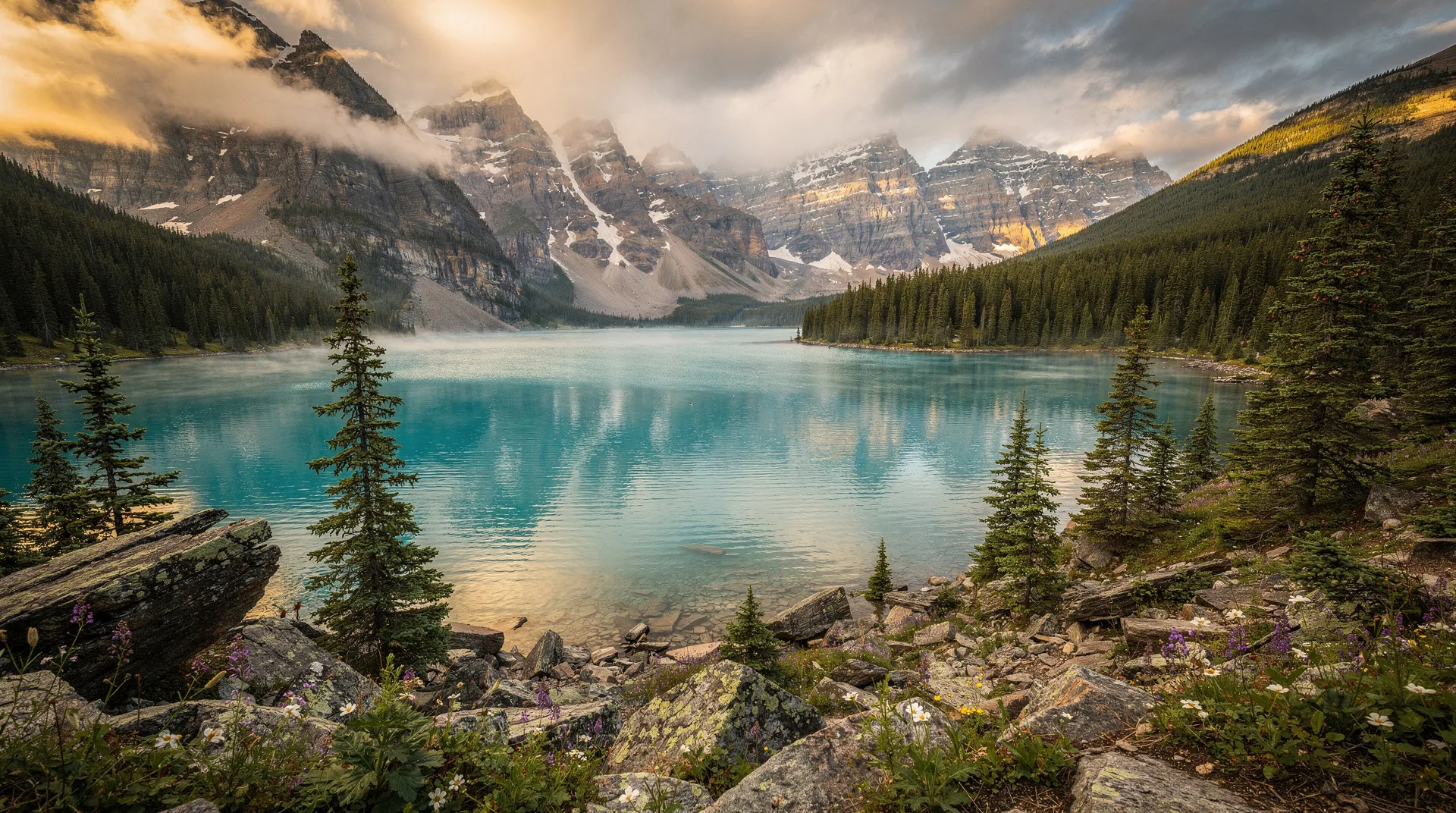
The Chic-Choc Mountains occupy the spine of the Gaspésie peninsula like a raised backbone, and Parc National de la Gaspésie covers their most dramatic central section — 802 square kilometres of boreal forest, subalpine meadow, and genuine arctic-alpine tundra at the highest elevations. This is not the tundra of the far north transported south by imagination; this is actual tundra, above the treeline, where the growing season is short enough that dwarf birch and crowberry and Labrador tea form the dominant vegetation and where the peaks are swept clear of snow only from late June in a light year.
The park’s fame rests on three things: the summit experience of Mont Jacques-Cartier (1,268 metres, the highest peak in the Appalachians east of the Rockies outside of Newfoundland), the peculiar geological and botanical character of Mont Albert, and the Gaspésie woodland caribou herd — a population of fewer than 90 individuals that represents one of the most critically threatened large mammal populations in eastern Canada. The park is the only place in Quebec where caribou can reliably be seen south of the Saguenay, and the sight of a caribou on the alpine tundra, with the St. Lawrence visible as a silver line on the horizon to the north, is one of those encounters that doesn’t require embellishment.
Mont Jacques-Cartier: the high point
At 1,268 metres, Mont Jacques-Cartier is the highest summit in Quebec east of the Rockies. This is not by western mountain standards a high mountain — it is high by eastern North American standards, and the altitude alone does not explain the experience. What makes the summit significant is what happens at 900 metres: the forest ends. Above that elevation, the boreal spruce and fir give way to krummholz (stunted and windblown dwarf trees), and then to open tundra with low-growing heaths, sedges, and rocks.
The standard day-hike route begins at the park interpretation centre and climbs approximately 8 kilometres to the summit, with around 730 metres of elevation gain. The trail is well-marked and maintained, with some steep sections on the upper plateau. Total time for fit hikers is 5–6 hours return; allow more if you plan to spend time on the summit observing caribou.
The summit plateau is caribou habitat and is closed to hikers on some days and in some conditions to minimise disturbance to the herd. Parks Quebec staff manage access; check current status before planning your summit day. When the plateau is open, the probability of seeing caribou is significant — perhaps 60–70% on clear days when the herd is on the high ground.
The view from the summit on a clear day extends northward to the St. Lawrence (visible as a broad silver line on the horizon) and southward into New Brunswick. The presence of genuine arctic tundra flora — including several species not found at lower elevations anywhere in Quebec — at what is by any measure a modest altitude is a consequence of the peninsula’s exposure to maritime weather systems that push treeline much lower than would be expected at this latitude further inland.
Mont Albert: the serpentinite plateau
Mont Albert presents a different experience from Jacques-Cartier despite being only slightly lower (1,154 metres). The mountain is composed largely of serpentinite rock — an ultramafic rock that contains high concentrations of magnesium and chromium and very low concentrations of calcium and other nutrients. The chemistry of serpentinite soils is inimical to most plants, and the result is a flora that appears almost lunar: sparse, low-growing species that have evolved to tolerate the mineral stress, some found nowhere else in Quebec.
The plateau of Mont Albert, once you gain the rim and look across, appears at first to be barren rock with occasional patches of miniature vegetation. Walking across it reveals something more complex: a community of highly specialised plants, including endemic varieties of certain alpine species, growing in the thin soil pockets between rock outcrops. Botanists have been drawn to Mont Albert for over a century.
The standard route to the Mont Albert plateau is the Sentier du Mont-Albert, approximately 9 kilometres return with considerable elevation gain. The ascent through the krummholz belt is among the most dramatic trail sections in the park — the trees shrink progressively as you climb, from full height forest to knee-high tangles, to the open plateau above.
The multi-day traverse: The park’s backcountry trail network allows a multi-day traverse of the main peaks, including Jacques-Cartier, Albert, and several lesser summits. This requires advance planning, backcountry camping permits, and reliable weather assessment — the plateau elevations are exposed and the weather can deteriorate rapidly.
The Gaspésie caribou herd
The woodland caribou of the Gaspésie population are at the edge of their range in every sense — ecological, geographic, and demographic. They are the southernmost woodland caribou population in eastern Canada, separated from any other caribou population by hundreds of kilometres. The herd peaked at around 700 individuals in the early 20th century and has declined to fewer than 90. The decline is attributed to a combination of factors: predation pressure from coyotes and wolves that followed human development into the region, habitat fragmentation from forestry and roads, and parasitic disease transmitted by moose.
The park and Quebec’s wildlife management agencies have invested significantly in caribou conservation — wolf and coyote management zones around the park, moose reduction in critical habitat areas, and close monitoring of each known individual. The results have been partial: the population has stabilised but not recovered significantly.
Encountering caribou on the summit plateaux of Jacques-Cartier or the adjacent highlands is both a privilege and a reminder of how precarious the existence of this population is. The large, calm animals with their distinctive white neck patches and unusually large, spread hooves (adaptations for walking on snow) are visually distinctive from the other deer species in the region, and their social structure — typically small groups of 3–8 individuals in summer — makes sightings intimate rather than overwhelming.
Book Quebec hiking and nature tours on GetYourGuideOther hiking options
Beyond the two signature peaks, the park offers trails for all abilities.
Sentier des Lacs-de-Gaspé: A 21-kilometre trail (typically done as an overnight with backcountry camping) through the park’s southeastern highlands, passing several lakes and offering consistent moose habitat. This trail has the highest probability of moose encounters in the park.
Lac-Cascapédia trail: A shorter and gentler walk (8 km return) to the attractive lake that sits below the Mont Albert massif. Good for families and those acclimatising to the park before attempting the high peaks.
Sentier des Skieurs: A 25-kilometre multi-day route in the northern section of the park, used in summer for hiking and in winter for cross-country skiing. The route passes through varied forest habitat with excellent bird activity — boreal specialties like black-backed woodpecker, gray jay, and boreal chickadee.
When to visit
July and August: The main hiking season. Most trails are snow-free. Caribou on the summit plateaux are most regularly seen. Weather is most stable, though alpine fog and rain are always possible at any time.
Late September: The fall colour season in the Gaspésie highlands is exceptional — the dwarf birch and alpine heath turn brilliant red and gold while the boreal forest below transitions through yellows and oranges. Temperatures are cool (5–15°C at park elevations) and crowds are thin. This is perhaps the most visually spectacular period.
June: The snow retreats from the high plateaux in mid-to-late June in most years. The snowmelt creates excellent stream and waterfall conditions and spring wildflowers are good at mid-elevations. The summit plateau may still have snow patches.
Winter: The park is open for Nordic skiing and snowshoeing. The Gîte du Mont-Albert provides winter lodging and is the hub for winter activities.
Where to stay in and near the park
Gîte du Mont-Albert: The park’s own auberge, located at the base of Mont Albert in the valley. A comfortable mountain lodge with private rooms and meals available. Popular with hikers doing multi-day itineraries. Must be booked well in advance for summer weekends.
Camping within the park: The park has two campgrounds — Camping Mont-Albert (the main serviced site with electrical hookups) and Camping Lac-Cascapédia (simpler and more rustic). Both must be reserved through Sépaq (the Quebec parks reservation system) well in advance for July and August.
Sainte-Anne-des-Monts: The coastal town 30 km north of the park on Highway 132, with hotels, motels, and restaurants. Auberge Festive Sea Shack here has developed a good reputation for combining accommodation with outdoor guiding.
Getting to Parc de la Gaspésie
The park is accessed from Sainte-Anne-des-Monts on the north shore of the Gaspésie peninsula, via Route 299 south from Highway 132. The park entrance is approximately 38 km from Sainte-Anne-des-Monts.
From Quebec City: Highway 20 east to Rivière-du-Loup, then Highway 132 east along the St. Lawrence coast to Sainte-Anne-des-Monts. Total distance approximately 450 km (4.5–5 hours).
There is no public transport to the park. A car is essential.
Explore Canada national park tours on GetYourGuideRelated pages
- Gaspésie region overview — planning the full peninsula circuit
- Forillon National Park — the peninsula tip experience
- Bas-Saint-Laurent region — the gateway region from Quebec City
- Quebec whale watching guide — the north shore marine dimension
Frequently asked questions about Parc National de la Gaspésie: Chic-Chocs, Mount Albert and Caribou
Do I need a permit to hike Mont Jacques-Cartier? No special permit is required for day hikes. A Sépaq day-pass (park entry fee) is required. Backcountry camping requires advance reservation and a camping permit through the Sépaq reservation system.
Are the high summits accessible for non-expert hikers? Mont Jacques-Cartier requires solid physical fitness and appropriate footwear but no technical climbing skills. Mont Albert’s plateau is similarly non-technical. Both require preparation for cold and wind — the plateau temperature can be 10°C lower than the valley, and weather changes quickly.
Can I see caribou without hiking to the summit? Caribou occasionally come down to lower elevations, particularly in late season. The valley trails near the park centre sometimes produce sightings. However, the high probability sightings consistently come from the summit plateau areas. The summit hike is the best approach.
What equipment do I need for the park? Full alpine day hiking preparation: waterproof jacket and pants, warm mid-layer, hat and gloves (even in August at summit elevations), good hiking boots, navigation (the park provides trail maps at the visitor centre), food and water for the full day. Trekking poles are useful on the descent.