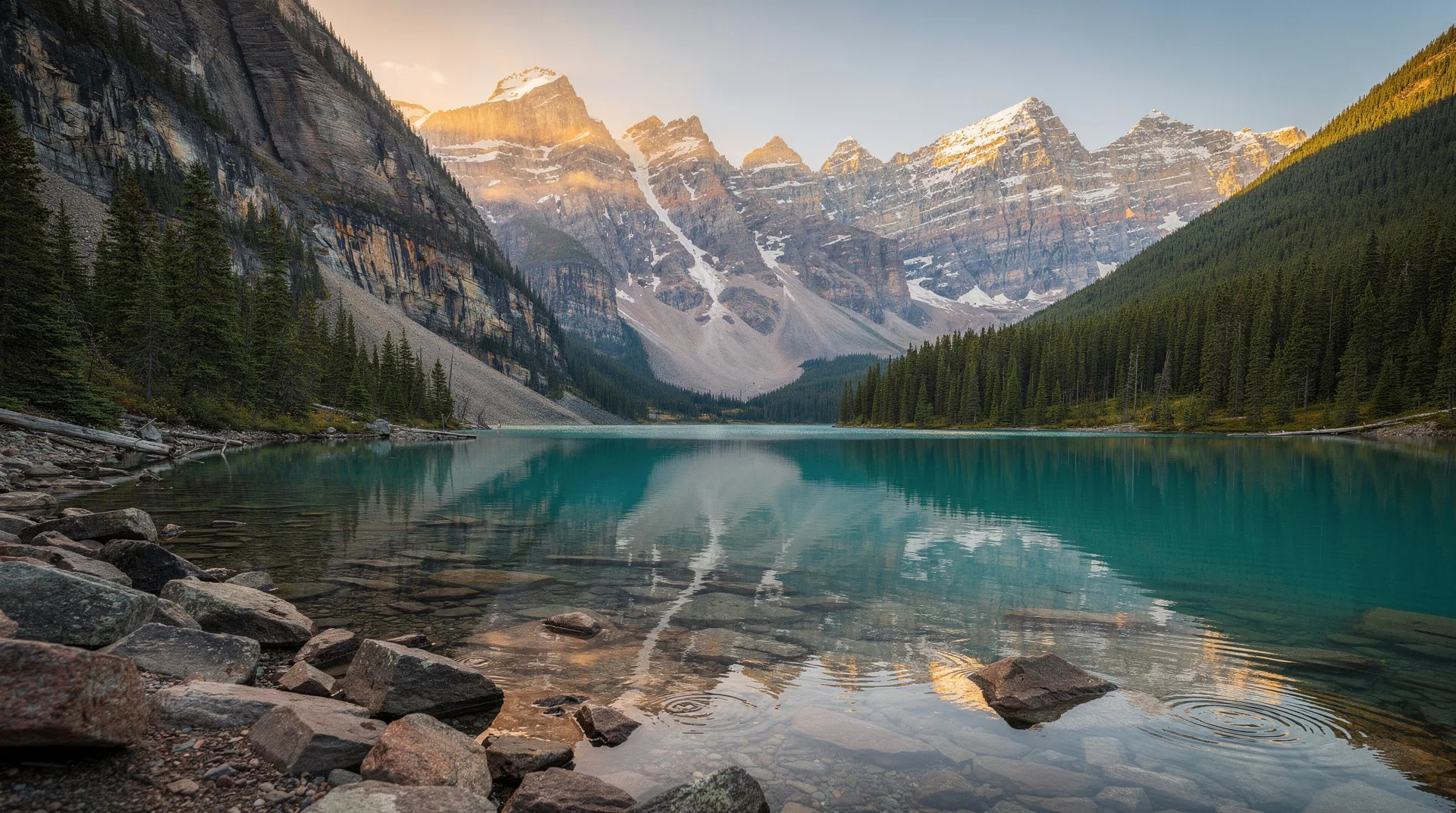
Quick facts
- Located in
- Gulf of St. Lawrence, Côte-Nord, Quebec
- Best time
- June–September
- Getting there
- Flight from Sept-Îles or Havre-Saint-Pierre; ferry from Sept-Îles
- Days needed
- 4-7 days
Anticosti Island is larger than Prince Edward Island. It is accessible only by plane or boat. It has approximately 200 permanent residents and roughly 160,000 white-tailed deer — one of the densest deer populations of any landmass on Earth. It contains canyons where rivers have cut through fossiliferous limestone to expose geological sequences covering 60 million years of Ordovician and Silurian time. It became a UNESCO World Heritage Site in 2023 for the quality and accessibility of its ancient marine fossils. And it is one of the most remarkable and least-known destinations in all of Canada.
| At a glance | |
|---|---|
| Where | Gulf of St. Lawrence, off Quebec’s Côte-Nord coast |
| Cost | Around $200-400 CAD return flight from Sept-Îles, plus $300-500/day for lodging, vehicle and activities |
| Time needed | 4-7 days |
| Getting there | Flight from Sept-Îles or Havre-Saint-Pierre, or the seasonal CTMA ferry from Sept-Îles |
| Best time | June to August for canyons and wildlife; September for the deer rut |
The island’s improbable history begins with Henri Menier, a French chocolate magnate who purchased the entire island in 1895 for the equivalent of $125,000 and spent the next two decades developing it as a private hunting reserve — stocking it with Virginian deer (which had no predators and the entire island’s forest to browse), constructing roads, lodges, and a model village at Port-Menier on the western end.
Menier’s deer introduction transformed the island’s ecology and left behind a deer population that has grown without meaningful predator control for 130 years. The island changed hands several times after Menier’s death, passed to Quebec’s provincial government in 2001, and is now managed as a combination provincial park, managed wildlife reserve, and tourism destination.
The UNESCO World Heritage designation
Anticosti Island received UNESCO World Heritage designation in 2023 as part of the “First Settlements of Vertebrates on Land” serial site that also includes Miguasha National Park in Gaspésie. The designation recognises the island’s Ordovician and Silurian limestone sequences — rock formations between 440 and 480 million years old that preserve marine invertebrate faunas of extraordinary diversity and completeness.
While Miguasha’s significance is in the Devonian (the fish-tetrapod transition), Anticosti’s geological value is somewhat earlier in the evolutionary story — the Ordovician and Silurian record of marine life before the colonisation of land. The island’s limestone cliffs and canyon walls expose these sequences with a clarity and length (hundreds of metres of continuous rock section in the major canyons) that is exceptional globally.
What the fossils include: Nautiloids (ancestors of the modern nautilus), trilobites, corals, bryozoans, crinoids (sea lilies), brachiopods, and early jawless fish fragments are all present in the Anticosti limestone. Many are preserved in three dimensions within the rock matrix rather than compressed flat, allowing the original shape to be studied. The island has been a significant destination for professional paleontologists since the late 19th century.
Visitor access to the fossils: Unlike Miguasha (where fossils are accessed primarily through guided interpretation), on Anticosti the fossils are visible throughout the canyon walls and along river beds accessible to any visitor who reaches them. Picking up and examining fossils on the island surface is permitted for personal non-commercial use (collecting and removing fossils remains regulated); this creates an unusually hands-on experience for geology-interested visitors.
The canyon system
Anticosti’s rivers have cut through the limestone plateau over thousands of years, creating a series of spectacular canyons whose walls expose the complete geological sequences that drew UNESCO attention.
Canyon de la Vauréal: The island’s most dramatic canyon — approximately 5 km long and up to 70 metres deep, cut by the Vauréal River through grey limestone cliffs. The canyon walls expose continuous rock sequences from the Ordovician period, and the river at the canyon bottom is accessible at several points via trail. Waterfalls within the canyon (including the 76-metre Chute Vauréal, visible from the canyon rim) make it a landscape as well as a geological destination.
Canyon de la Caverne: A shorter but very dramatic canyon near the south coast of the island, where the river passes through a series of underground caverns before re-emerging at the surface — an unusual karst feature in the limestone. The cave section is accessible with guided tours.
Chute McDonald: A 30-metre waterfall on the eastern part of the island, associated with spectacular canyon scenery and one of the most photographed locations on Anticosti.
Jupiter River canyon system: The Jupiter River (the island’s longest river and the most famous Atlantic salmon river on Anticosti) passes through canyon sections on its way to the sea, with accessible viewpoints and riverside trails.
The deer: 160,000 white-tailed deer
The white-tailed deer population on Anticosti is the central feature of the island’s ecology and, increasingly, one of the key elements of the tourism experience. The island has no natural predators — wolves and coyotes have never crossed to Anticosti, and the deer Menier introduced 130 years ago have reproduced into a population that has browsed the island’s forest so heavily that the forest has changed character. The understory is essentially absent in most areas — deer eat everything within reach — and the forest is open in a way that makes deer viewing extraordinarily easy.
Deer densities: With approximately 160,000 deer on 7,900 square kilometres, the density is roughly 20 deer per square kilometre — 10 to 20 times higher than typical mainland deer population densities. The result is that deer are visible on any drive or walk at any time of day. It is not unusual to see 20–50 deer visible simultaneously from a single viewpoint.
The deer rut: In late September and October, the white-tailed deer rut brings the males (bucks) into visible, active competition. Bucks make scrapes, rubs, and vocalise through this period, and the chance of close encounters with large-antlered males is highest. This is why traditional hunting tourism brings several thousand hunters to the island each autumn — Anticosti has been one of the premier white-tailed deer hunting destinations in North America for over a century.
Non-hunting wildlife watching: Québec now manages part of the island’s territory as the Parc national d’Anticosti, where hunting is prohibited and wildlife watching is the primary activity. The park covers the western section of the island and includes the best canyon scenery. Wildlife watching visitors can observe deer in non-hunting territory without concern about the active hunt.
Book Quebec wilderness and UNESCO heritage tours on GetYourGuideAtlantic salmon fishing
The rivers of Anticosti — particularly the Jupiter, the Salmon, and the Vauréal — are among the most storied Atlantic salmon rivers in North America. The salmon return to these rivers from late June through September, and the catch-and-release fishing (salmon licence required) on Anticosti is managed as a premium sport fishery. The combination of the island’s remoteness, the scenery of the river canyons, and the quality of the salmon runs draws fly fishing enthusiasts from across North America and Europe.
The island has a history of salmon fishing at the exclusive level — Henri Menier himself built private fishing lodges, and the tradition of high-quality sport salmon fishing on Anticosti has continued through successive ownership. Several outfitters on the island manage guided salmon fishing for those with appropriate licences.
Practical logistics for visiting Anticosti
Getting to Anticosti: The only practical access is by air (from Sept-Îles or Havre-Saint-Pierre, with Air Anticosti and other small carriers operating scheduled and charter services — flight time is about 1 hour from Sept-Îles) or by the Sept-Îles to Port-Menier ferry (CTMA operates seasonal service taking approximately 12 hours). The ferry is the option for those bringing vehicles to the island.
Port-Menier: The island’s only permanent settlement, at the western end, where flights arrive and the ferry docks. Population approximately 200. All services — small grocery, fuel, the park visitor centre, most accommodation — are concentrated here.
Road network: The island has approximately 600 km of gravel roads built for the former hunting concession operations. A 4x4 vehicle is strongly recommended for reaching the remote canyons and rivers. ATV/UTV rentals are available at Port-Menier for those arriving without vehicles.
Self-sufficiency: Outside Port-Menier, services are essentially absent. Fuel, food, first aid supplies, and communication equipment (satellite phone or PLB) are required for extended exploration of the island’s interior.
Where to stay on Anticosti
Pourvoirie du Lac Geneviève and similar hunting lodges: Several of the former hunting lodges on the island take paying guests for nature and wildlife watching visits as well as hunting seasons. These lodges range from comfortable to rustic and are the primary accommodation option outside Port-Menier.
Gîtes in Port-Menier: A small number of bed-and-breakfast and gîte operations in the village.
Camping: The Parc national d’Anticosti has designated camping sites. Reserve through Sépaq well in advance.
The former hunting club lodges: Several well-equipped lodges (now managed by the park or by outfitters) deep in the island’s interior provide base camps for multi-day canyon exploration and deer watching. These must be booked through the park or relevant outfitters.
When to visit
June–August: The primary season for canyon exploration, fossil finding, waterfall viewing, and deer watching. Insects (blackflies and mosquitoes) are intense in June; by mid-July they have diminished significantly. Atlantic salmon are running in June and July.
September: The deer rut begins and bucks are active. Some insects remain but are much reduced. The boreal forest shows early colour change in the final weeks of September.
October: Full deer rut and hunting season. Non-hunters should be aware that active hunting occurs in most of the island outside the park boundaries. The park’s non-hunting areas are the appropriate destination for wildlife watching visitors in this season.
Discover Canada’s remote island destinations on GetYourGuidePairing Anticosti with the rest of the Côte-Nord
Most visitors reach Anticosti via Sept-Îles or Havre-Saint-Pierre, both of which are worth a day or two in their own right rather than pure transit points. Havre-Saint-Pierre is also the gateway to the Mingan Archipelago, whose limestone monoliths formed from the same Ordovician seabed as Anticosti’s canyons — visiting both on the same Côte-Nord trip means seeing two expressions of the same geological story a short flight or ferry apart.
The Côte-Nord region overview covers how to sequence a longer north-shore itinerary, and travellers connecting from Quebec City should look at the Quebec whale watching guide since whale-watching operators along the Gulf overlap with the same summer season as Anticosti’s canyons and salmon runs.
Because flights to Anticosti are small-capacity and infrequent, build in a buffer day on either side in Sept-Îles or Havre-Saint-Pierre — weather delays are common on this coast and a missed connection can cost a full day of the trip.
Related pages
- Côte-Nord region overview — the full north shore guide
- Mingan Archipelago — the monolith islands near Havre-Saint-Pierre
- Miguasha UNESCO site — the companion UNESCO geological site in Gaspésie
- Quebec whale watching guide — whales in the Gulf context
Frequently asked questions about Anticosti Island: Quebec’s UNESCO Geological Wonder
Is Anticosti Island safe to visit outside hunting season? Yes. Outside the hunting season (roughly October–December), the island is completely safe for all visitors. During hunting season, non-hunters should stay within the Parc national d’Anticosti boundaries where hunting is prohibited.
How much does it cost to visit Anticosti? The primary costs are the flight (roughly $200–400 CAD return from Sept-Îles) or ferry passage, accommodation (moderate to expensive given the remoteness), and vehicle rental. Budget a minimum of $300–500 per day per person for total costs including accommodation and activities. Guided packages that include flights, accommodation, and excursions are available from operators in Sept-Îles.
Can I visit Anticosti as a day trip? A day trip is technically possible by plane but allows only 4–5 hours on the island, which is sufficient for Port-Menier and one nearby canyon or trail. The island genuinely rewards 4–7 days. A day trip gives a sense of the landscape but doesn’t do it justice.
Do I need a guide to explore the canyons? For the main accessible canyons (Vauréal, those near Port-Menier), no guide is required if you have appropriate navigation skills and equipment. For remote sections and the cave systems, local guide knowledge is strongly advisable. The park office at Port-Menier provides current information on trail conditions and access.
How does Anticosti compare to the Mingan Archipelago? They are complementary rather than competing. Anticosti is a large island with canyons, deer and multi-day exploration; the Mingan Archipelago is a cluster of small islands visited on day-boat tours from Havre-Saint-Pierre, known for its limestone monoliths, puffins and seals. Both draw on the same Ordovician geology and both are reachable from Havre-Saint-Pierre, so a Côte-Nord trip can reasonably include both.