Quick facts
- Distance from Charlottetown
- 40 km northwest
- Best time
- July and August
- Languages
- English
- Days needed
- 2-3 days
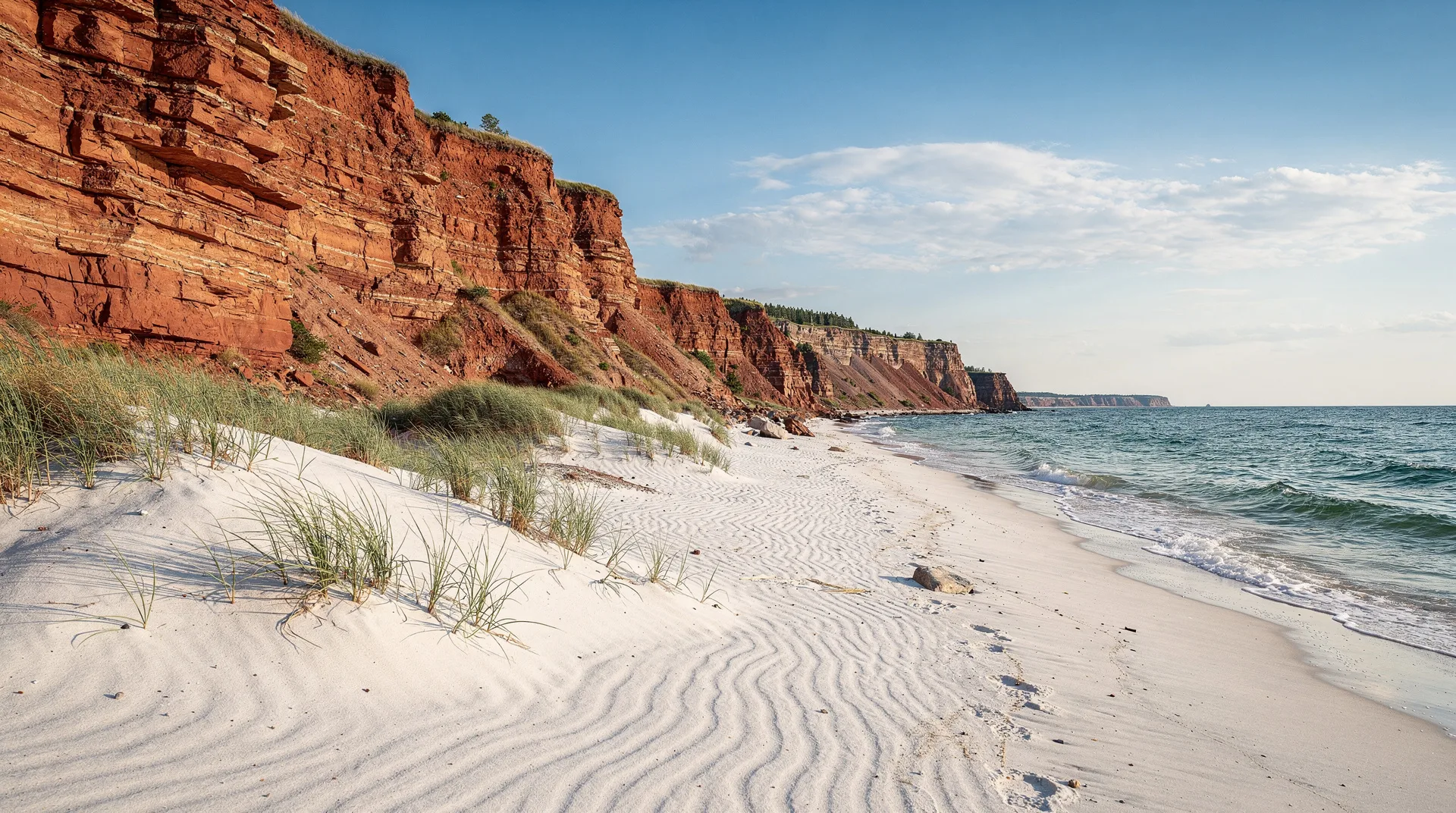
The red sand beaches of Cavendish, Prince Edward Island, have been a summer destination since the railway arrived on the island in the 1870s. The Northumberland Strait beaches in this part of northern PEI heat to some of the warmest ocean temperatures on Canada’s east coast — 20-24°C in mid-July, the colour of rust from the iron-rich sandstone that erodes into the coastal dunes. The combination of reliably warm water, long gentle beaches, and the literary heritage of L.M. Montgomery, whose fictional Anne of Green Gables grew up in the farmland behind these dunes, has made Cavendish the most visited rural area on Prince Edward Island.
The visitor experience at Cavendish is layered: a national park beach and parks system at the centre, a commercial tourism zone of considerable density around it (amusements, waterparks, golf courses, restaurants, lobster suppers), and the more authentic landscapes of L.M. Montgomery’s fiction — the farmhouses, the red roads, the rolling green fields coming down to the sea — available to those who look past the commercial district.
This is genuinely a family destination in the most complete sense: children will be happy at the beach and at the amusements; adults have the PEI National Park trails, the golf, the lobster suppers, and the literary landscape to occupy them. The island’s cycling infrastructure (the Confederation Trail) makes Cavendish accessible as part of a cycling itinerary.
At a glance
| Where | North shore of PEI, around 40 km northwest of Charlottetown |
| Cost | Beach and heritage sites require a Parks Canada day pass or Discovery Pass (around CAD 10-15 per adult per day); most amusements charge separately |
| Time needed | 2-3 days for beaches, Green Gables sites, and one lobster supper |
| Getting there | Self-drive via Route 2/Route 6; no scheduled public transit serves the area |
| Best time | Late July and August for warm water; June or September for a quieter visit |
The beaches of PEI National Park
The beaches at Cavendish and the adjacent communities of North Rustico and Brackley Beach are protected within Prince Edward Island National Park — a long strip of barrier beaches, sand dunes, and coastal wetlands running east-west along the north shore. The park beach system preserves the finest beach habitat on the island against the development pressure that surrounds it.
Cavendish Beach is the most central and most visited — a long crescent of red-tinged sand with gentle offshore sand bars that create shallow paddling areas ideal for children. The beach has lifeguarded zones in summer, a boardwalk through the dunes, and full facilities.
North Rustico Beach, a few kilometres east, is slightly less crowded and has the same sand and water temperature. The fishing village of North Rustico at its eastern end adds a working harbour with boat tours available.
Brackley Beach and Stanhope Beach further east in the national park have a quieter, less commercial character and excellent birdwatching in the adjacent Dalvay area.
The sand dunes of the national park — some of the best-developed coastal dune systems in Atlantic Canada — are protected from foot traffic and support a distinctive coastal plant community. The boardwalk access through the dunes to the beach protects the vegetation while providing excellent views of the dune structure.
Important note on water temperature: PEI beaches are warmest in late July and August, when the Northumberland Strait has been warmed by the summer sun. Early in the season (June, early July) the water is significantly cooler.
Browse Prince Edward Island tours and beach experiencesAnne of Green Gables and the L.M. Montgomery heritage
L.M. Montgomery published Anne of Green Gables in 1908, and the novel’s setting in the Cavendish farmland of PEI created one of the most enduring acts of literary tourism in North American history. The house that belonged to Montgomery’s cousins and inspired the description of Green Gables in the novel — the place Anne Shirley arrives as an orphan — is within PEI National Park and draws visitors from around the world, particularly from Japan, where the novel has been read by generations and holds a place in the cultural imagination comparable to its place in Canadian literature.
Green Gables Heritage Place (within the national park, operated by Parks Canada) is the farmhouse, outbuildings, and surrounding landscape that provided Montgomery’s setting. Costumed interpreters explain the literary history and the farming context. The Haunted Wood trail through the adjacent forest — named for a stand of spruce that Montgomery described as feeling haunted — leads to Lovers Lane, the wooded path that appears throughout the Anne books.
Site of L.M. Montgomery’s Cavendish Home (privately operated, a short distance from Green Gables) marks the location of the actual house where Montgomery grew up and wrote the novel. The original house is gone, but the site with its heritage garden and interpretive displays draws fans of the work.
L.M. Montgomery’s Cavendish National Historic Site and the Anne of Green Gables Museum at Silver Bush in nearby Park Corner (20 kilometres west) add further dimensions to the Montgomery heritage for serious readers of the novels.
The commercial district around Cavendish has fully embraced the Anne identity — “Annetrepreneurial” is a term used by locals with some irony for the cottage industry of Anne-related products, experience, and image. The heritage of the actual novel is more genuinely encountered at the national park sites than in the commercial district.
The commercial zone and amusements
Cavendish’s commercial tourism zone is substantial and unabashed — waterparks, go-karts, minigolf, amusement rides, haunted houses, and a full complement of summer entertainment operations that cater primarily to families with children. This is not accidental or inappropriate for the destination — PEI’s summers are short and the commercial operators have developed a product that works for the market they serve.
Sandspit Amusement Park, Shining Waters Family Fun Park, and the various minigolf operations are reviewed on current family travel sites and TripAdvisor with appropriate detail for parents planning visits. These are not attractions that require extended coverage in a travel guide — they are what they are, and they are well executed within their category.
Golf on Prince Edward Island
Cavendish and the surrounding north shore area is one of Canada’s most celebrated golf regions, with several courses that regularly appear in national rankings. Green Gables Golf Course (within the national park, designed by Stanley Thompson) is the historic centrepiece — a 1939 design using the rolling farm landscape adjacent to the Green Gables farmhouse. The Links at Crowbush Cove (40 kilometres east) and Dundarave Golf Course at Brudenell (80 kilometres east) complete the north shore golf circuit.
PEI golf packages are popular with visitors who combine beach time with early morning rounds on courses that offer exceptional quality at lower prices than comparable Canadian courses.
Cycling and the Confederation Trail
The Confederation Trail — a 470-kilometre rail-trail network crossing the island — passes through or near the Cavendish area, connecting to Charlottetown and the rest of the island. The trail surface is crushed stone suitable for hybrid bikes.
The Gulf Shore Parkway within PEI National Park is a cycling road — largely closed to motor vehicles during certain hours — that runs along the coastal dune system and provides access to all the park beaches by bicycle. Cavendish to North Rustico to Brackley Beach by bicycle along the parkway is one of the finest cycling routes in Atlantic Canada.
Bicycle rentals are available in Cavendish and at several locations adjacent to the national park.
Food and the lobster supper tradition
PEI’s food culture is centered on its exceptional seafood — oysters, mussels, lobster, and fish from the surrounding waters — and Cavendish is no exception. But Cavendish has also maintained a specific food institution unique to PEI: the church lobster supper.
Church lobster suppers are fundraising events hosted by rural churches, typically in June and July, serving whole steamed PEI lobster with rolls, chowder, salads, and dessert in a community hall setting. New Glasgow Lobster Suppers (15 kilometres south of Cavendish) and St Ann’s Church Lobster Suppers in Hope River are the most celebrated — events that have been running since the 1950s and serve hundreds of visitors nightly through the summer. These are not tourist performances — they are genuine community fundraisers that happen to have become essential visitor experiences.
The combination of a whole PEI lobster (exceptionally fresh, PEI’s island waters being some of the best lobster habitat in the Atlantic), homemade rolls, and dessert in a church hall full of locals and visitors is one of the most honest food experiences available in Atlantic Canada.
When to visit Cavendish
July and August are the only real answer for beach-focused visitors — the water is warmest, all attractions are fully operational, and the summer atmosphere is at its peak. This is also the most crowded period.
June has the beach without the peak crowds, though the water is cooler. The golf courses and trails are excellent in June.
September is the transition month — the beach season extends (water remains warm from summer heat), crowds thin dramatically, and prices fall. The national park is still fully operational.
October sees most commercial attractions close, but the national park remains open for hiking and cycling in the excellent fall weather.
| Month | Water | Crowds | Notes |
|---|---|---|---|
| June | Cool (around 14-18°C) | Light | Golf and cycling at their best; some amusements still ramping up |
| July-August | Warmest (around 20-24°C) | Heavy, arrive early for beach parking | Full commercial season, church lobster suppers running |
| September | Still mild | Thin out fast after Labour Day | National park and most trails still open, lower prices |
| October | Cold for swimming | Minimal | Amusements largely closed; good for hiking and dune walks |
Making the most of a short visit
Visitors with only a single day tend to over-schedule: trying to combine the beach, Green Gables, golf, and a lobster supper in one afternoon usually means rushing all four. A more realistic single day pairs the beach in the morning (before the parking lots fill) with Green Gables Heritage Place in the afternoon, saving the amusements or a lobster supper for the evening. With two or three days, splitting mornings between beaches and cycling the Gulf Shore Parkway, and afternoons between the literary sites and the golf courses, gives each activity the time it deserves without the rush.
Families travelling with young children should note that the commercial amusement zone and the national park beaches are a short drive apart rather than intermixed — a rental car or at minimum a short taxi hop is needed to move between them, since nothing in Cavendish is realistically walkable end to end.
Browse Charlottetown and Prince Edward Island tour experiencesGetting there and around
Cavendish is 40 kilometres northwest of Charlottetown via Route 2 and Route 6. Charlottetown has an airport (YYG) with connections to Toronto, Montreal, and Halifax. The Confederation Bridge (from New Brunswick) and the Northumberland Ferries service (from Caribou, Nova Scotia to Wood Islands) are the vehicle connections to the mainland.
A car is essentially necessary for the Cavendish area — the attractions are spread across a wide area and no public transit serves the tourist zone.
Related destinations
Charlottetown is 40 kilometres southeast — PEI’s elegant capital, the Birthplace of Confederation. The PEI Culinary Trail guide covers the island’s food culture including oysters, mussels, and the farm-to-table scene. The Anne of Green Gables Heritage Circuit covers the full L.M. Montgomery literary landscape. Prince Edward Island provides the comprehensive island overview.
Honest verdict
Cavendish is worth it for families with children, beach-focused travellers, and anyone with a genuine attachment to the Anne of Green Gables novels — the combination of warm ocean swimming, a real national park, and a well-run commercial tourism zone is hard to match elsewhere in Atlantic Canada. It’s worth skipping, or treating as a half-day stop, for travellers who dislike commercial tourist strips or who have limited time and want PEI’s quieter, more historic side — in which case Charlottetown is the better base. Book Green Gables Heritage Place tickets and any lobster supper reservation ahead in July and August; the beach itself needs no advance booking, just an early arrival.
Mistakes to avoid
- Arriving at Cavendish Beach after 10am on a July or August weekend — why: the small parking areas fill quickly and there is no overflow lot; how to avoid: arrive before 9am or use Brackley or Stanhope Beach instead.
- Assuming June ocean water will feel like August — why: Northumberland Strait water is still cold (14-18°C) in early summer; how to avoid: plan swimming-focused trips for late July through August.
- Booking only one Green Gables site — why: Green Gables Heritage Place and the Site of L.M. Montgomery’s Cavendish Home cover different parts of the story; how to avoid: budget time for both if the literary connection matters to you.
- Skipping a car rental — why: Cavendish’s attractions are spread out with no public transit; how to avoid: rent a car in Charlottetown, 40 km away, or arrange transport before arrival.
- Missing the church lobster suppers because they weren’t researched in advance — why: they run on a limited summer schedule and can have long lines; how to avoid: check current dates for New Glasgow or St Ann’s suppers before your trip.
Frequently asked questions about Cavendish
Is the Anne of Green Gables house in Cavendish the real house?
The Green Gables Heritage Place in PEI National Park is the farmhouse that belonged to relatives of L.M. Montgomery and that she used as the model for Green Gables in the novel. It is the “real” setting in the sense that Montgomery knew it well and drew on it for the book’s descriptions. The house where Montgomery actually grew up and wrote the novel is a separate site nearby.
How warm is the water at Cavendish Beach?
Sea temperatures at Cavendish typically reach 20-24°C in late July and August — genuinely warm for ocean swimming by Canadian east coast standards. Early in the season (June, early July) water temperatures are cooler (14-18°C). The warmest water of the year is usually found in the last two weeks of July and first two weeks of August.
How crowded is Cavendish in summer?
Very crowded in July and August, particularly on beach days. The parking areas at Cavendish Beach fill by mid-morning on sunny weekends. Arriving early (before 9am) is strongly recommended. The park beaches at Brackley and Stanhope, slightly farther east, are typically less crowded.
Do you need a Parks Canada pass for the beaches?
Yes — the beaches at Cavendish, North Rustico, Brackley, and Stanhope are within Prince Edward Island National Park. A Parks Canada day use pass or discovery pass is required for beach access. The Green Gables Heritage Place also requires a pass.
Is Cavendish or Charlottetown a better base for a PEI trip?
It depends on the priority. Cavendish suits beach-focused and family trips with easy access to PEI National Park and Green Gables. Charlottetown suits travellers who want restaurants, walkable heritage streets, and Confederation history, with Cavendish an easy 40-minute day trip. Many visitors split their stay between the two.
How many days should you spend in Cavendish?
Two to three days covers the beach, Green Gables Heritage Place, and one lobster supper without rushing. A single day is workable if you pick one beach visit and one heritage site rather than trying to fit in the amusements and golf as well.