Quick facts
- Population
- Tobermory: 500
- Best time
- June–September
- Languages
- English
- Days needed
- 3-5 days
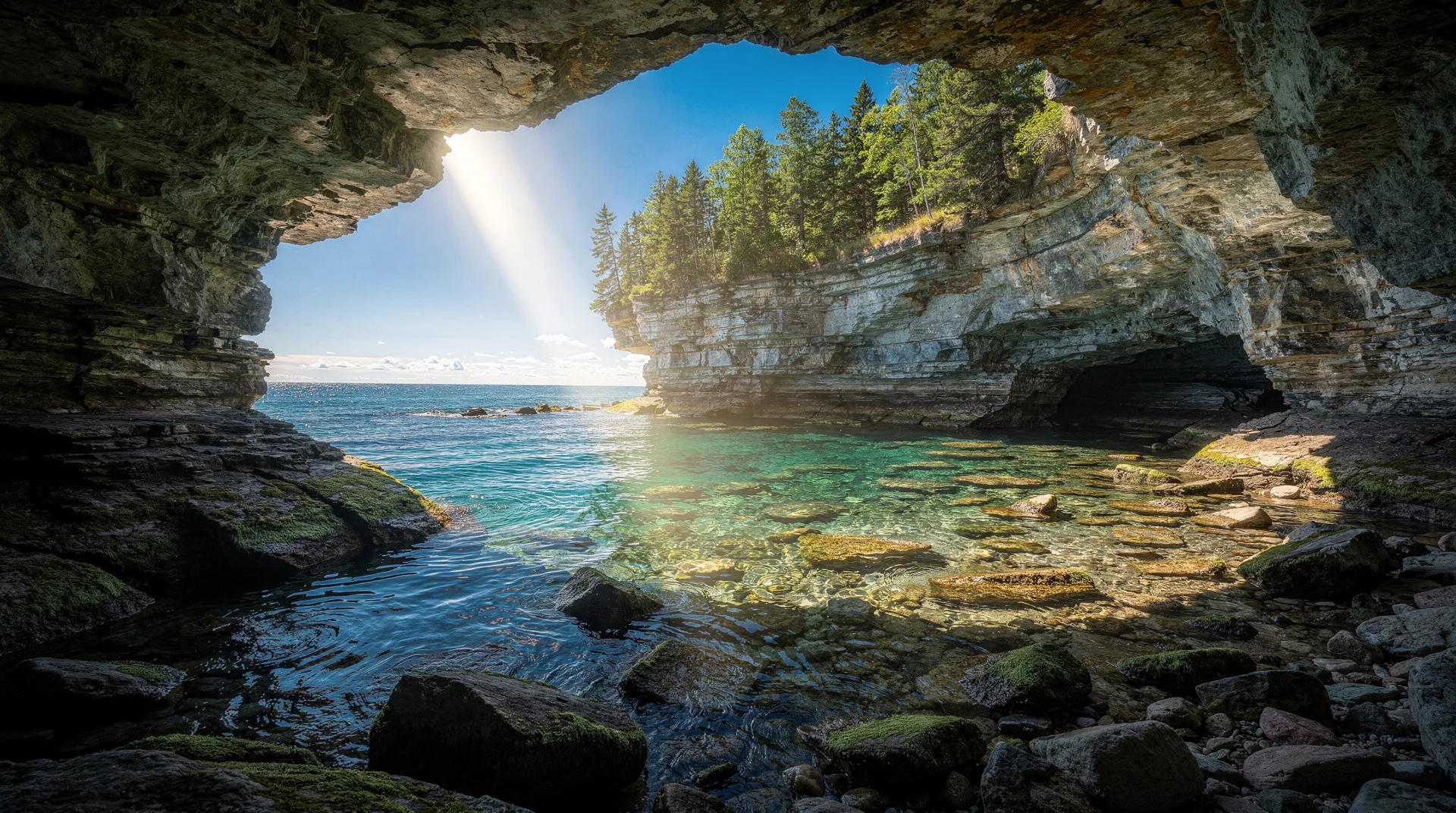
The Bruce Peninsula is Ontario’s wild edge. This narrow finger of limestone extends 100 kilometres northwest into Georgian Bay, separating it from Lake Huron, and its tip at Tobermory contains some of the most dramatic and most visited wilderness in the province. Crystal-clear water in improbable shades of turquoise laps against grey limestone cliffs. The Bruce Trail ends here after 900 kilometres from Niagara. Flowerpot Island’s sea stacks stand in water so clear that the bottom is visible 15 metres down. And at the Grotto — a sea cave in the cliff face of Georgian Bay — the combination of cave geology, colour-charged water, and precipitous cliff diving has made it one of the most photographed spots in Ontario.
The peninsula is divided between Bruce Peninsula National Park, which protects the core of the tip, and Fathom Five National Marine Park, which covers the waters around Tobermory and its 20 surrounding islands. Together they form one of the few places in Ontario where wilderness — genuine, unmodified, and demanding — is accessible without a multi-day backcountry expedition. The national park’s day trails bring visitors to the cliffs and caves within a couple of hours of the car park. The marine park’s ferry takes visitors to Flowerpot Island for the afternoon.
Tobermory, the village at the very tip of the peninsula, has a permanent population of around 500 people that swells enormously in summer. Its twin harbours — Big Tub and Little Tub — provide moorings for the ferries, dive boats, glass-bottom boats, and kayak tour operators that make up the summer economy.
| At a glance | |
|---|---|
| Where | Tip of the Bruce Peninsula, Georgian Bay, roughly 300 km / 3.5-4 hours from Toronto |
| Cost | Free to hike; Grotto trail parking and Flowerpot Island ferry both charge a fee, and a Parks Canada pass applies inside the national park |
| Time needed | 3-5 days to cover the Grotto, Flowerpot Island, and a dive or kayak outing |
| Getting there | Self-drive via Highway 400/26/10/6; the Chi-Cheemaun ferry connects onward to Manitoulin Island |
| Best time | July-August for warm water and full access; September for smaller crowds and no timed-entry requirement |
Top things to do on the Bruce Peninsula
The Grotto, Bruce Peninsula National Park
The Grotto is the most visited single spot on the Bruce Peninsula and for good reason: it is genuinely extraordinary. A sea cave formed where Georgian Bay’s waves have undercut the limestone cliff, it opens at water level to a chamber with a sky window above and water the colour of polished malachite below. The stone shelf at the cave entrance functions as a natural diving platform; in summer, cliff jumping here is a contested tradition (officially discouraged by Parks Canada, actively practised by visitors).
The approach is via the Georgian Bay Trail from the Cyprus Lake Campground day-use area — approximately 3.5 kilometres and 45 minutes each way on a trail that winds through the limestone pavement forest before descending to the cliff edge. Along the trail, additional viewpoints at Indian Head Cove and the cliff terraces above offer their own perspectives on the Georgian Bay coast. The pavement itself — a rare ecosystem where rainwater-dissolved limestone creates flat terraced rock with plants growing in the solution hollows — is botanically significant and visually unusual.
Timed entry passes are required for the Grotto trail from late June through Labour Day (early September). These sell out days or weeks in advance and must be booked through the Parks Canada reservation system before arrival. No walk-up access is available during the reservation window. Book as far ahead as possible — ideally the day reservations open each season.
Book guided Bruce Peninsula and Georgian Bay outdoor experiencesFlowerpot Island, Fathom Five National Marine Park
Flowerpot Island gets its name from the two sea stacks — natural rock columns separated from the main island by erosion of the surrounding limestone — that stand in the shallow water off its southern shore. The stacks, 5 metres and 7 metres high respectively, are among the most-photographed landforms in Ontario and are entirely accessible on foot from the dock where the Tobermory ferry lands.
The island has a cave trail (15 minutes from the dock), lighthouse (a restored 1885 light at the island’s north end), and campsite for those who want an overnight. The ferry from Tobermory takes 30–45 minutes depending on the vessel, and round-trip tickets include a glass-bottom boat section that passes over the wreck sites in the harbour approaches — several 19th-century wooden schooners lie in shallow water with their ribs and planking clearly visible through the glass-bottomed panels.
Day trips to Flowerpot Island should be booked in advance through Blue Heron Company or Chi-Cheemaun ferry connections; the number of ferry departures limits the island’s capacity and peak summer slots fill quickly.
Scuba diving the Fathom Five wrecks
Fathom Five National Marine Park was Canada’s first national marine park, designated in 1987 to protect a remarkable concentration of 19th-century shipwrecks in the waters around Tobermory. The cold, clear, and remarkably fresh Georgian Bay water has preserved these wooden hulks in extraordinary condition — the sweeping curves of the Arabia (1884), the angular iron hull of the Niagara II (1907), and the timber-and-chain of the smaller schooners are all accessible to divers at depths ranging from 5 to 35 metres.
Visibility in the Fathom Five waters regularly reaches 15–20 metres, making these some of the best diving conditions in freshwater anywhere in the world. Dive operators in Tobermory (G&S Watersports, Divers Den) offer equipment rental, guided dives, and certification courses. Several of the shallower wreck sites are also snorkellable for non-divers.
The drive from Toronto (3.5–4 hours) makes Tobermory a challenging day trip for diving. Most diving visitors spend at least two or three nights in the area, with accommodation in Tobermory or along the peninsula in Lion’s Head or Wiarton.
Kayaking the Georgian Bay shoreline
Sea kayaking the limestone coast of the Bruce Peninsula is one of Ontario’s finest paddling experiences. The cliff-and-cave coastline, the island passages through Fathom Five, and the crystal water give a landscape that does not feel like Ontario in any conventional sense. On calm days, the water over the white-limestone bottom turns every shade from jade to sapphire depending on depth, and the scale of the cliffs from sea level is very different from the experience of standing on top of them.
Guided kayak tours operate from Tobermory (Thorncrest Outfitters, several others) with half-day, full-day, and multi-day options. The multi-day paddling expeditions, camping on the Fathom Five islands, are the most spectacular but require advance booking and permit coordination with Parks Canada. For independent kayakers with experience, kayak rentals are available and the route north along the Georgian Bay coast from Tobermory is excellent.
Hiking the Bruce Trail to Tobermory
The Bruce Trail runs the full length of the peninsula from South Bruce to Tobermory, with the northern sections through the national park offering the most dramatic cliff-and-cave scenery. Several marked side trails connect the main trail to swimming spots, viewpoints, and cave systems along the Georgian Bay shore.
The Tobermory terminus of the trail — on the cliffs above Little Tub Harbour — is a satisfying destination for day hikers who want to walk a section of this iconic route rather than hike the full 900 kilometres. The section from the Cyprus Lake day-use area to the Grotto and back to Tobermory is approximately 10 kilometres and is the most-walked stretch of the trail in summer.
Discover Canada’s national parks and wilderness experiencesWhen to visit the Bruce Peninsula
June: The Grotto reservation system begins but early June sees smaller crowds than July and August. The wildflowers on the limestone pavement are at their best in late May and early June. Water temperatures are still cold but the crowds are manageable.
July and August: Peak season. The Grotto timed passes are essential and sell out weeks ahead. Tobermory accommodation is fully booked on weekends. The Georgian Bay water reaches its warmest temperatures (18–22°C), making swimming and snorkelling comfortable. Every activity and attraction operates at full capacity.
September: An excellent month for hiking — the light is golden, the wildflowers are replaced by berries and autumn colour on the higher ground, and crowds drop sharply after Labour Day. The Grotto reservation requirement ends after Labour Day, allowing walk-up access. Water is still warm enough for diving and kayaking.
October to May: The peninsula is very quiet. Most Tobermory accommodation and services close for the winter. The Chi-Cheemaun ferry to Manitoulin Island operates on a reduced schedule. Winter hiking on the Bruce Trail is possible for well-equipped visitors and the frozen Bruce Peninsula coastline is starkly beautiful, but visitor infrastructure is minimal.
Where to stay
Tobermory has a range of motels, lodges, and cabin resorts within the village. Grandview Hills and similar properties sit on the edge of town with forest settings. The Pioneer Rock Bed and Breakfast and similar B&Bs provide more personalised accommodation. Book 2–3 months ahead for July and August weekends.
Lion’s Head (50 km south) is a pleasant alternative base with its own harbour and limestone headland access. Less frenetic than Tobermory in peak season and a better base for the central peninsula trails.
Camping at Cyprus Lake, within the national park, puts you in the ideal location for early morning trail access before the day trippers arrive. Cyprus Lake campground is the most sought-after booking on the entire trail system; the reservations open in January and popular sites fill within hours. The campground has a full range of tent sites, oTENTiks, and yurts.
Wiarton (80 km south): A larger town with full services and a good accommodation selection; a reasonable base for exploring the south and central peninsula but a long drive to Tobermory for day trips.
Getting there and around
From Toronto: Highway 400 north to Barrie, then Highway 26 to Collingwood, Highway 10 north through Owen Sound to Wiarton, then Highway 6 north to Tobermory. Total approximately 300 kilometres, 3.5 to 4 hours.
From Owen Sound: Highway 6 north, 80 kilometres, approximately one hour.
Ferry to Manitoulin Island: The Chi-Cheemaun (“Big Canoe”) ferry operated by Ontario Northland runs between Tobermory and South Baymouth on Manitoulin Island, a 1.75-hour crossing. This allows the Bruce Peninsula to be incorporated into a circuit that includes Manitoulin Island and the drive back south via the north shore of Lake Huron. Reservations are strongly recommended.
Getting around the peninsula: A car is necessary. The national park day-use area at Cyprus Lake (parking for the Grotto trail) is on a separate road from Tobermory village. Tobermory itself is walkable for harbour services and ferry departures.
What to eat on the Bruce Peninsula
Tobermory is a small village built around summer tourism, and its restaurant scene reflects this: casual, seasonal, and somewhat limited in ambition, but serviceable for refuelling between trail and dive sessions. The harbourfront has several fish-and-chip and casual dining spots that do good business through the summer. Tobermory Brewing Company operates a brewpub in the village that is a reliable option for an end-of-day meal.
For more serious eating, Lion’s Head (50 km south) and Wiarton (80 km south) have somewhat better restaurant options. Owen Sound, 80 kilometres south of Wiarton on the larger highway corridor, is the regional city for the Bruce area and has a full range of dining including several well-regarded independent restaurants in the downtown.
The Tobermory Farmers’ Market (Saturday mornings in summer, at the Community Centre) is small but worth visiting for local produce, baked goods, and jam. The surrounding Bruce County agricultural land — Grey County to the east produces excellent vegetables and some of Ontario’s best apple varieties — is represented at farm stands along Highway 6 on the drive north.
For self-catering, Tobermory’s limited grocery facilities (one small general store) are not ideal for provisioning a full camping stay. Stocking up in Owen Sound or Wiarton before heading north is advisable if you are planning meals at a campsite.
Day trips from Tobermory
Lion’s Head and the central peninsula: The section of the Bruce Peninsula between Wiarton and Tobermory contains several significant natural areas. Lion’s Head — a 25-metre limestone headland above the Georgian Bay village of the same name — is a fine viewpoint and marks the entry to the most rugged section of the peninsula. The Bruce Trail between Lion’s Head and Tobermory is one of the finest sections of the entire 900-kilometre trail.
Owen Sound: 80 kilometres south of Tobermory, Owen Sound is the service city for the Bruce Peninsula region and has the Tom Thomson Art Gallery (dedicated to the Group of Seven-adjacent painter who spent formative years in the area), the Billy Bishop Home and Museum, and a handsome downtown on the Sydenham River. A practical stop for restocking, banking, and equipment needs during a longer Bruce Peninsula stay.
Sauble Beach: On Lake Huron west of Wiarton, Sauble Beach is the Bruce Peninsula’s other significant beach — a 14-kilometre sand strand on Lake Huron that is less dramatic than Georgian Bay’s limestone coast but warmer and more accessible for families with young children. The beach is popular with southwestern Ontario vacationers and is considerably less crowded than Tobermory.
Practical tips
Grotto passes: Book as early as possible — ideally months ahead for July and August dates. Check the Parks Canada reservation site as soon as you have firm travel dates. Passes for popular July weekends disappear within hours of opening. If you arrive without a pass in the restricted season, the trail is closed to you.
Water shoes: The cliff swimming areas involve limestone shelving rather than sandy beaches. Water shoes protect feet from sharp edges and provide grip on wet rock.
Wildlife: Black bears are present in the Bruce Peninsula. Standard bear awareness practices apply: store food properly, make noise on trails, carry bear spray. Sightings are not uncommon but encounters are rare. Eastern Massasauga rattlesnakes — Ontario’s only venomous snake — are also present in the limestone pavement areas; they are shy and bites are extremely rare, but watch where you step and sit.
Carry cash: Tobermory’s smaller vendors and ferry operators have variable card acceptance. Cash is useful for parking, smaller food vendors, and tips.
Sun and water: The combination of limestone reflection and Georgian Bay water creates intense UV conditions. Sun protection is more important here than on typical Ontario beaches.
The geological story of the Bruce Peninsula
The Bruce Peninsula is the northern extension of the Niagara Escarpment — the same geological formation that creates Blue Mountain to the south and Niagara Falls to the southeast. At the Bruce Peninsula, the escarpment is at its most rugged and most clearly expressed: the cliff face on the Georgian Bay side rises directly from the water, while the Lake Huron side slopes gently down to long sand beaches.
The limestone and dolostone of the escarpment were laid down as seafloor sediment in the Silurian period, approximately 420 to 430 million years ago, when a warm shallow sea covered what is now Ontario. The fossils of corals, crinoids, and brachiopods — marine invertebrates of the Silurian ocean — are visible in the exposed rock of the escarpment throughout the Bruce Peninsula, and the limestone pavement areas (the flat, sculpted rock surfaces of the Grotto trail and the Georgian Bay coast) were formed as glacial meltwater dissolved the rock surface along the fracture lines in the stone.
The characteristic “karst” features of the Bruce Peninsula — sinkholes, caves, and underground water passages — all result from this limestone solubility. Rainwater carrying dissolved CO2 slowly eats through the limestone along fracture lines, creating cave systems, underground passages, and the dramatic cliff overhangs of the Grotto. The Grotto’s sea cave formed where Georgian Bay wave action exploited a pre-existing fracture in the cliff face, simultaneously attacking from outside while subterranean water dissolution worked from within.
The crystal clarity of Georgian Bay around the Bruce Peninsula results from this limestone geology: the water is filtered through the porous rock, and the limestone minerals in solution give the water its distinctive blue-green colour in shallow areas over white-limestone bottom.
Bruce Peninsula versus other Ontario escarpment stops
The Bruce Peninsula is the northern end of the same Niagara Escarpment that runs through Blue Mountain further south — see the Toronto to Blue Mountain guide if you’re weighing a shorter, more developed escarpment trip against the wilder Bruce.
Hikers wanting to understand the full length of the trail system, rather than just the Tobermory end, should check the Niagara Escarpment and Bruce Trail guide. For a different kind of Ontario wilderness trip in the same general region, Algonquin Provincial Park offers canoe-based backcountry rather than the Bruce’s coastal hiking and diving — useful context if you’re deciding which trip suits your group better.
Planning the park side of your trip
The Bruce Peninsula National Park guide goes deeper on the trails and the day-use areas than this overview can. Because the Grotto relies on timed entry in summer, the Parks Canada reservation system guide is worth reading before you sit down to book, and the Parks Canada Discovery Pass guide helps you decide whether a pass makes sense if you plan to visit other national parks on the same trip.
Anyone choosing dates should compare this page with the best time to visit Ontario guide, since the peninsula’s season is short and the trade-offs between crowds, water temperature and availability shape the whole visit. Paddlers who enjoy the Fathom Five coastline may also like the broader kayaking in Canada guide, and the Canada wildlife safety guide covers the bear and snake awareness mentioned above in more detail.
More Ontario wild places to pair with the Bruce
If the peninsula leaves you wanting more of Georgian Bay’s rocky shoreline, the wider Georgian Bay region has plenty to explore, and Killarney Provincial Park offers a quieter, more remote counterpart for hikers and paddlers. For a gentler, cottage-country pace, the Ontario cottage country guide and the Ontario provincial parks guide suggest ways to extend the trip without repeating the same landscape.
If you have extra time
Combining the Bruce Peninsula with Manitoulin Island via the Chi-Cheemaun ferry turns a peninsula trip into a genuine northern Ontario loop; allow at least two extra days for Manitoulin itself. Travellers short on time but wanting a taste of the escarpment closer to Toronto could instead do a long weekend at Blue Mountain, which trades the Bruce’s remoteness for shorter drive times and more developed amenities.
Is the Bruce Peninsula worth the drive from Toronto?
Yes — the Bruce Peninsula contains the most dramatic natural scenery in Ontario, and it is accessible in a single summer road trip from the city. The Grotto experience, when the water is clear and the light is right, is genuinely extraordinary rather than merely photogenic. Flowerpot Island, the diving, and the coastal kayaking all deliver on their promise. The key is planning: without Grotto passes and accommodation reservations made weeks in advance, a summer peak-season visit becomes a frustrating exercise in closed trails and no-vacancy signs.
Visitors who plan carefully and build in three to four nights will have enough time for the Grotto, a Flowerpot Island day trip, a dive or kayak excursion, and meaningful hiking on the Bruce Trail. That combination — concentrated in a landscape unlike anything else in the province — justifies the distance from Toronto with ease.
Frequently asked questions about Bruce Peninsula
Do I need to book the Grotto in advance? Yes, from late June through Labour Day, timed entry passes are mandatory and there is no walk-up access; book through the Parks Canada reservation system as soon as your dates are set. Outside that window, walk-up access returns.
Can I visit the Bruce Peninsula as a day trip from Toronto? It’s possible but not ideal — the drive alone is 3.5-4 hours each way, leaving little time on the peninsula itself. Most visitors get far more value from at least one overnight in Tobermory or Lion’s Head.