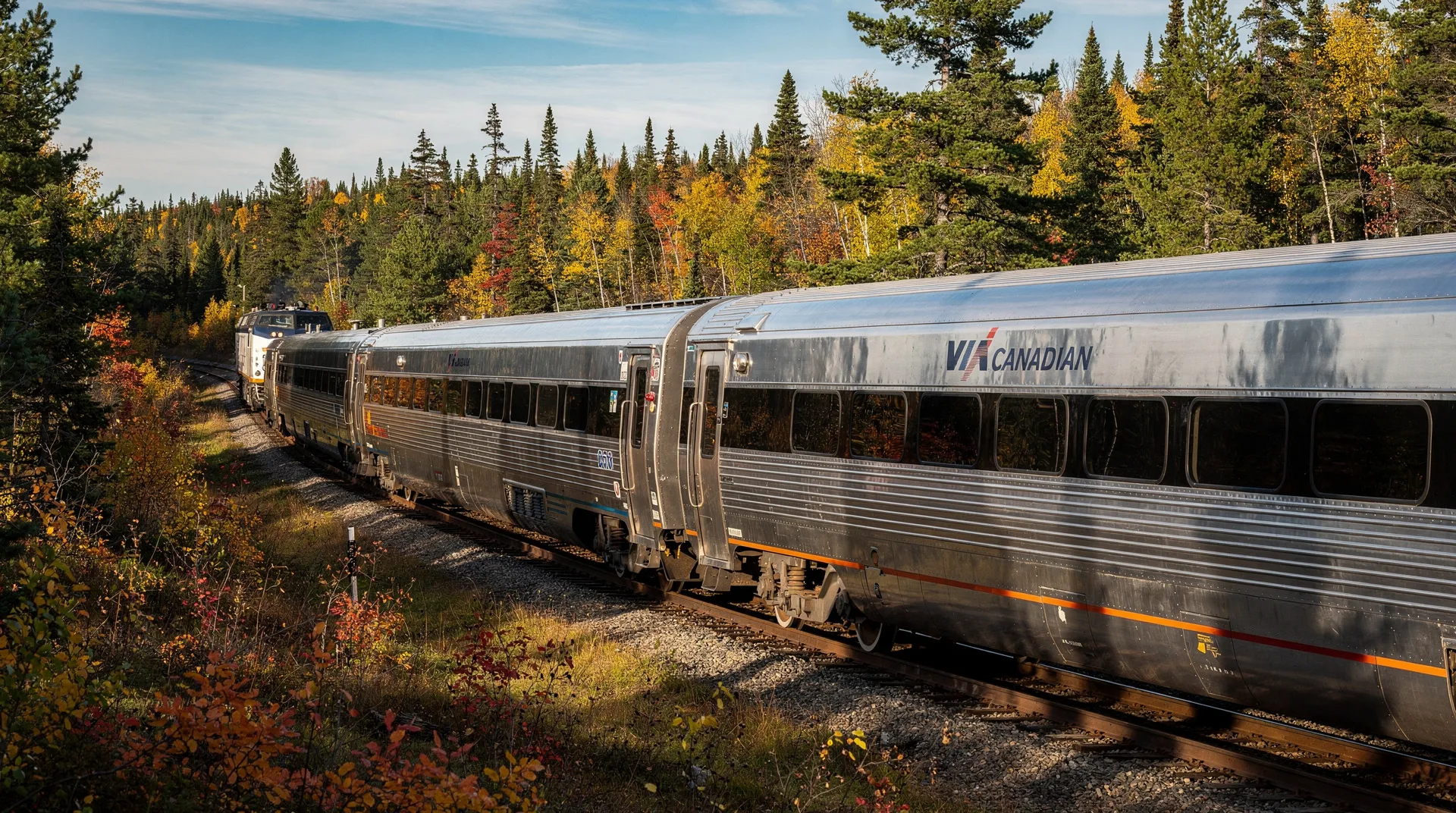
VIA Rail: why train travel is the best way
Somewhere in the middle of the third day on The Canadian — VIA Rail’s transcontinental train between Toronto and Vancouver — the mountains appeared. We had been crossing the Alberta prairies since the previous afternoon: flat, golden, enormous sky, the occasional grain elevator breaking the horizon. Then the land began to rise, tentatively at first, and by the time I went to the dining car for breakfast the next morning, the Rockies were fully present outside the windows, the train threading through river valleys at the foot of peaks that rose directly from the valley floor.
| At a glance | |
|---|---|
| Route | The Canadian, Toronto to Vancouver, 4,406 km |
| Duration | Around 3-4 days (scheduled ~87 hours, delays of a few hours common) |
| Cost | Around CAD $200-500 Economy per person; around CAD $700-1,500 Sleeper Plus Roomette per person, meals included |
| Booking lead time | Months ahead for summer Sleeper Plus; the Rocky Mountaineer is a separate, pricier private operator |
| Best time | Summer for daylight through the Rockies; shoulder seasons for fewer passengers and lower fares |
I had taken the train because it seemed like the right way to cross Canada — a country assembled by railways, whose distances were only comprehensible to its settlers once the Canadian Pacific Railway connected the coasts in 1885. What I hadn’t fully anticipated was that the journey itself would be the experience I’d remember most vividly from the entire trip.
What VIA Rail actually is
VIA Rail Canada is the national passenger rail service, operating routes across most of the country. It is not high-speed. It is not particularly punctual by European standards — The Canadian operates on tracks that freight trains take priority on, and delays of several hours are common on the longer routes. It is not inexpensive. And for all of these reasons, it is a travel experience that has essentially no equivalent in Canada and very few equivalents anywhere in the world.
The network covers the main population corridors (Toronto–Montreal–Ottawa, the Halifax corridor, Niagara and southwestern Ontario) where it functions as practical regional transport, and the long-distance transcontinental routes where it functions as something else entirely — a way of seeing Canada at ground level, at a pace that allows the landscape to accumulate meaning rather than being glimpsed from 30,000 feet.
The flagship route is The Canadian: Toronto to Vancouver (or reverse) in three to four days, 4,406 km, through the Precambrian granite of the Canadian Shield, the boreal forest of northern Ontario, the prairie provinces, and the Rocky Mountains of British Columbia.
The classes and accommodation
Economy class seats are comfortable enough for the shorter routes but challenging for three-plus days. Reclining seats, overhead storage, access to the dining car for food purchases, and the ability to move freely through the train. For budget travellers and those who sleep well in seats, this works; for most people, three days in a seat is a test of commitment.
Sleeper Plus is the most popular class for the transcontinental journey. Choices include:
- Roomette: A private room for one or two passengers with fold-down beds, a large picture window, and all meals included in the dining car. The smallest private option and the one most first-time transcontinental passengers take.
- Bedroom: Larger private room with a separate enclosed toilet and shower, fold-down beds, meals included.
- Cabin for two: A popular choice for couples or friends, with daytime sofa seating that converts to berths, shared corridor shower, meals included.
Prestige class (available on The Canadian) is the premium option: larger rooms, enhanced service, dedicated observation car access.
The meal inclusion in Sleeper Plus means you’ll spend three mornings, lunches, and dinners in the dining car — shared tables with other passengers, meals prepared on board, and the landscape passing outside. This is where much of the social magic of the train happens.
The dining car as social hub
The dining car on The Canadian operates on shared seating: you’re seated at tables of four regardless of your travelling party. This is the design choice that makes the dining car different from simply eating in your roomette (which is possible and sometimes necessary when running behind schedule). Strangers share tables and, in the context of three days on a train crossing a continent, conversations tend to go somewhere.
I sat across from a retired schoolteacher from Saskatchewan on the first dinner who had taken the train annually for thirty years. She knew the names of every river the train crossed in the Shield, which she recited with the gentle authority of a person sharing something genuinely precious. On the second morning, a couple from Germany on their fourth visit to Canada, comparing the train crossing to a drive they’d done on a previous trip, concluded that the train had won comprehensively because “you can actually sit still and look at it.”
The food is good but not remarkable — standard Canadian hotel dining quality, competently prepared in a moving kitchen. The point is not the food. The point is the room, the company, and the window.
The observation car and the landscape
The Park Car — the dome-observation car at the rear of The Canadian — is available to all Sleeper Plus passengers and is where you go to see the mountains properly. The curved dome glass gives a 360-degree view of the sky and a wraparound view of the landscape. In the Rockies, particularly through the Fraser Canyon and the mountain sections approaching Vancouver, this becomes one of the most visually overwhelming spaces you will occupy.
The Canadian Shield section — northern Ontario through Sudbury and on toward Winnipeg — is often described as the boring part of the journey by travellers impatient to reach the mountains. I found it compelling in a different way: the granite lakes, the boreal forest, the geological antiquity of the rock, the absence of any human settlement for hours at a stretch. This is the part of Canada that most travellers skip entirely by flying over it, and experiencing it at ground level for a day reveals something about the country’s scale and character that the mountain photographs don’t capture.
Practical notes: booking, timing, and cost
Booking: VIA Rail tickets are available online through the VIA Rail website. Book well in advance for the transcontinental routes — Sleeper Plus accommodation in particular sells out months ahead in summer. The Escape fares (flexible date, advanced purchase) offer the best prices but book quickly.
Cost: A Toronto–Vancouver Roomette booking typically runs CAD $700–1,500 per person in Sleeper Plus, depending on date, booking lead time, and specific room type. Economy class runs CAD $200–500 per person. The Sleeper Plus price includes three days of meals, which reduces the effective cost difference. The Canrailpass offers flexibility for multi-journey travel.
Duration and reliability: The official schedule is about 87 hours Toronto to Vancouver. In practice, The Canadian frequently runs two to six hours late due to freight priority. The delayed arrivals rarely matter because the destination is rarely the point — and Vancouver arrivals in the early morning (which the schedule anticipates) are often better for accommodation logistics if you arrive at noon instead.
Best direction: Westbound (Toronto to Vancouver) takes you toward the mountains — you’re building to the Rockies, and the revelation of the mountains after three days of prairie has a narrative logic. Eastbound is equally scenic but the prairie section comes last. Most first-timers choose westbound.
Explore other Canadian travel experiences and tours that complement a VIA Rail journey — the train gets you across the country; activities and experiences at each end make the journey complete.
When the train makes more sense than flying
The train wins over flying for The Canadian and other long-distance VIA routes when: you have three or four days to spare and the journey itself is part of what you want; you are moving between cities with no specific time pressure at either end; you want to see the country from ground level; you find airports and flying stressful; or you specifically want a social experience rather than an isolated transit.
The train loses to flying when: time is the constraint; your destination is not on the VIA network; you’re travelling in Economy class for multiple days (a test of endurance); or the cost difference is prohibitive.
For the Toronto–Montreal–Ottawa corridor, VIA Rail is genuinely competitive with flying when you factor in airport time — city centre stations mean no 90-minute travel to the airport, and check-in is straightforward.
The other great VIA routes
While The Canadian attracts the most attention, other VIA routes offer exceptional experiences:
The Ocean: Montreal to Halifax (22 hours), passing through New Brunswick’s Bay of Fundy region and the forests of the Maritimes. Less dramatic than the Canadian Rockies section but an excellent overnight train with genuinely beautiful countryside.
Winnipeg to Churchill: Three nights each way through the sub-Arctic boreal forest to Churchill on Hudson Bay. The train is the only surface access to Churchill, and the journey through increasingly remote terrain is an experience with no road equivalent.
The Corridor: The high-frequency Toronto–Montreal–Ottawa service is comfortable, reliable by VIA standards, and a genuine alternative to driving or flying for these routes.
The VIA Rail guide has more detailed route information, booking advice, and packing recommendations for multi-day train journeys.
VIA Rail vs Rocky Mountaineer
People planning a Rockies rail trip often confuse these two, so it’s worth being precise. VIA Rail’s Canadian is a national passenger service that runs day and night, with sleeper cabins doubling as your hotel room; the Rocky Mountaineer is a private luxury tour operator that only runs during daylight, stopping overnight in a hotel so you never miss the scenery to darkness.
| VIA Rail (The Canadian) | Rocky Mountaineer | |
|---|---|---|
| Runs at night | Yes, you sleep on board | No, overnight hotel stops instead |
| Typical cost | Around CAD $700-1,500 (Roomette, meals incl.) | Substantially more, often several thousand CAD |
| Scenery coverage | Full route including the Canadian Shield and prairies | Focused Rockies-to-coast routes, daylight only |
| Feel | National transport with a social dining car | Curated tour-style experience with glass-dome cars |
If budget matters and you want the whole cross-country story, VIA Rail’s Sleeper Plus is the better value. If the Rockies section specifically is the priority and budget is flexible, the Rocky Mountaineer delivers a more polished daytime-only version of the same landscape. A detailed route-by-route comparison is in our Rocky Mountaineer vs VIA Rail guide.
Making the most of the Rockies section
However you book, the stretch through Jasper and the mountain approaches deserves planning. Keep your camera out and charged through the afternoon the train enters the foothills — cloud cover can change the light within minutes, and the best mountain views are unpredictable rather than guaranteed on a schedule that’s often running late anyway. If you have flexibility, pairing the train with a few extra days in Banff National Park or along the Icefields Parkway turns a transit day into a proper Rockies trip rather than a single dramatic afternoon seen from a train window. To fill those extra days, you can browse guided tours across Canada before you travel.
Final thoughts
I arrived in Vancouver on the fourth morning of my Canadian crossing sunburned from sitting in the dome car, having slept better on a moving train than I’d expected, carrying a sheaf of paper napkins with phone numbers from dining car conversations, and with a physical understanding of Canada’s geography that no amount of flying over it had given me.
The train is slow, sometimes very late, and costs more than the equivalent flight. It is also, for certain trips and certain travellers, the only way that makes sense — the way that lets the country be what it is rather than reducing it to the sum of its airports.
Frequently asked questions about VIA Rail: why train travel is the best way
How far in advance should I book VIA Rail?
For transcontinental routes (The Canadian, The Ocean) in summer or over holidays, four to six months in advance is not too early for Sleeper Plus. Economy class has more availability. For the Corridor routes (Toronto–Montreal–Ottawa), a few weeks in advance is usually sufficient outside holiday periods.
Is the VIA Rail train worth the extra cost over flying?
For the transcontinental journey specifically: the train costs significantly more than a budget flight but includes meals, private accommodation, and the experience of crossing Canada at ground level. Whether it’s “worth it” depends on whether you value the journey itself. Most people who take it consider the cost justified. For the Corridor routes, the cost is competitive once you factor in airport transfers.
What should I pack for a multi-day train journey?
Layers (the train temperature varies), entertainment for the flatter stretches, a good book, quality headphones, comfortable shoes that come on and off easily. For Sleeper Plus, a small overnight bag with toiletries for easy access — your main luggage is stored at the end of the car. Camera fully charged. The observation dome windows are excellent for photography.
Are there showers on The Canadian?
Yes — Sleeper Plus passengers have access to shared shower facilities in the sleeper cars. Bedroom and Prestige rooms have en-suite bathrooms. Roomette and Cabin passengers use the shared showers, which require scheduling to avoid queues. They’re functional and clean.
Is VIA Rail or the Rocky Mountaineer better for the Rockies?
They serve different priorities. VIA Rail’s Canadian covers the whole cross-country route including an overnight through the Rockies, at a lower price. The Rocky Mountaineer only travels by daylight with overnight hotel stops, at a significantly higher price, and is focused specifically on the mountain scenery. See our Rocky Mountaineer vs VIA Rail guide for a full comparison.
Can I get on and off The Canadian along the route?
Yes, VIA Rail allows stopovers on multi-day tickets at intermediate stations such as Winnipeg or Jasper, though fare rules and availability vary — check the specific fare type when booking, since the cheapest Escape fares are more restrictive than flexible fares.