Solo travel in Canada: my experience
I spent three weeks travelling Canada alone on my second trip there, after a first visit with a friend had convinced me that the country deserved more of my time. The friend was unavailable. The trip was planned. I went anyway, and those three weeks turned out to be the most formative travel experience I’ve had — not because Canada is particularly exotic or challenging as a solo destination, but because travelling alone forces a different kind of attention and openness that group travel dilutes.
Canada, as it turns out, is an excellent country to travel solo in. This is partly its practical character — safe, organised, English-speaking in most of the country, with reliable infrastructure and a culture of helping confused visitors — and partly something more specific to Canadian culture that I noticed consistently across different regions.
| At a glance | |
|---|---|
| Best first-solo regions | Rockies (Banff/Jasper), Quebec City, Vancouver |
| Typical extra cost vs. sharing | Around 30-40% more per person (single room, no split transport) |
| Safety | Among the world’s safest countries; standard urban and wilderness precautions apply |
| Social route | VIA Rail’s the Canadian, hostels, small-group guided tours |
| Best time | Shoulder seasons (May-June, September) for easier bookings and manageable crowds |
Why Canada works well for solo travellers
Canadians are genuinely friendly with strangers in a way that isn’t universally true in more densely populated countries. This is a generalisation and a cliché, but it held up to sustained solo travel experience. Sitting alone at a bar in Halifax produced three conversations with locals before my food arrived. A fellow hiker on the Skyline Trail in Cape Breton spent two hours telling me about her family’s Acadian history. A truck driver who pulled over to check if I was alright on a Quebec highway — I had stopped to look at a map — ended up giving me a half-hour primer on the best places to eat between Quebec City and the Gaspésie.
This sociability is partly a small-population phenomenon — Canada has 38 million people spread over 10 million square kilometres, and the relative sparseness creates a culture where strangers acknowledge each other. It’s also partly a function of Canada’s immigration culture, which has historically made accommodation of newcomers a social default rather than an exception.
Solo travel rewards this kind of openness because you’re available for it in a way that pairs or groups aren’t. When you’re alone at a restaurant, locals are more likely to talk to you. When you’re alone at a viewpoint, you’re more likely to start a conversation with someone else who’s alone. The trip accumulates these small human moments in a way that feels qualitatively different from travelling with company.
Safety for solo travellers
I’ll address this directly because it comes up in nearly every discussion of solo travel, particularly for women travelling alone: Canada is one of the safest countries in the world for solo travellers of any gender.
Violent crime against tourists is extremely rare. The cities — Toronto, Vancouver, Montreal, Quebec City — have the same urban caution requirements as any large city (awareness of surroundings, particular care in certain neighbourhoods at night, standard precautions with valuables) but nothing beyond what a careful traveller applies automatically. The rural and wilderness areas are safe in a different way: the hazards are natural (wildlife, weather, terrain) rather than human, and they’re manageable with preparation.
For solo wilderness hiking specifically — which is one of the great pleasures available in Canada — the precautions are about self-reliance and emergency preparedness rather than safety from other people. Tell someone your itinerary. Carry bear spray in the Rockies. Have offline maps. Carry emergency supplies for an unexpected night out. None of these is onerous, and they apply to solo and group hiking alike.
The loneliness question
The thing people who haven’t done extended solo travel often ask is whether it’s lonely. The honest answer: sometimes, yes, and those moments are part of the experience rather than failures of it.
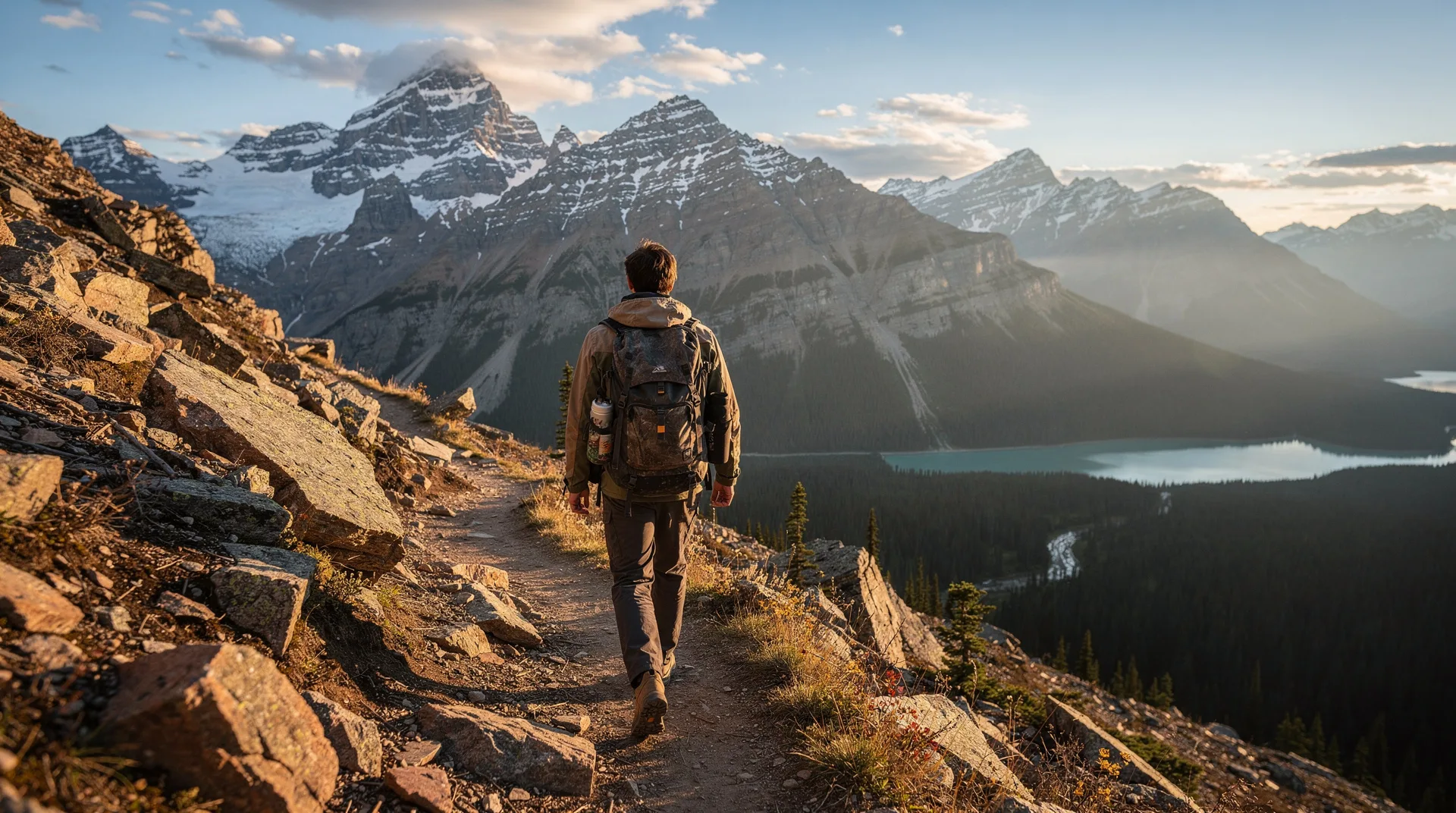
In Canada specifically, the loneliness arrived most sharply in places of overwhelming beauty. Standing at the Moraine Lake Rockpile at 6 am with only two other people on the rocks, the lake below a colour that has no everyday equivalent, the peaks reflected in the still water — I wanted badly to share that with someone specific. The solitude amplified the beauty in one direction and the absence of a particular person in another direction simultaneously.
This is not an argument against solo travel. It is an argument for accepting that solo travel is its own experience with its own emotional texture, not a compromised version of travel with company. The conversations you have when alone are different. The decisions you make are different. The pace is entirely yours. These are genuine advantages that group travel doesn’t offer, even if the Moraine Lake moment would have been better with someone beside you.
What I’d plan differently
Three weeks solo, I covered Vancouver, the Rockies (Calgary, Banff, Jasper), the VIA Rail train to Toronto, Toronto itself, a bus to Quebec City, a few days in Montreal, and a flight back from Montreal. In retrospect:
The train was the best decision. The Canadian (VIA Rail from Vancouver to Toronto) takes three to four days and is, for a solo traveller, the single best social environment in the country. The dining car brings together strangers at shared tables three times a day, and I met more interesting people on that train than in the two weeks on either side of it combined. A retired geologist who explained the rock formations visible through the prairie. A Mennonite family from rural Manitoba going to Toronto for the first time. An Australian couple who had been travelling Canada for three months and knew more about the country than most Canadians I met.
I should have booked a guided tour for Banff. Going solo in the Rockies is entirely possible — the hiking is well-marked, the townsite has excellent gear shops, and the park’s visitor centres provide all the information you need. But I missed context that a guide would have provided. A multi-day guided Banff and Jasper tour would have given me the geological and ecological background that makes the landscape more legible, and the social element of a small group tour would have been welcome in the middle of the trip’s most isolated section.
Quebec City deserved more time. I gave it two days. It needs four or five, particularly if you’re solo and can move at your own pace through the old town, the cafés, the museum of civilisation, the walk along the Promenade des Remparts at dusk. It is one of the most walkable and socially comfortable cities in Canada for solo travellers — small enough to feel intimate, large enough to be constantly interesting.
Practical tips for solo travel in Canada
Accommodation: Hostels in the major cities are genuinely good options — well-equipped, safe, and social in ways that solo hotel stays aren’t. HI Canada (Hostelling International) operates a network of good properties in most tourist centres. Budget solo travellers can make a hostel dorm work in places where private accommodation is expensive (i.e., Banff in summer).
Transport: Canada is not easily navigated without a car in most regions. For solo travellers, renting a car solo means paying the full rental cost without splitting it — this adds up. The VIA Rail network is an excellent alternative for the main east-west corridor. For the Rockies specifically, weighing the car rental cost against a guided tour may make a tour the more economical option.
Tours for solo travellers: Guided day tours and multi-day experiences are social by nature and a good antidote to the solitude that extended solo travel can produce. They’re also more economical than they appear when you factor in the accommodation, transport, and activity costs they include. The range of guided experiences across Canada is broad enough to build significant parts of a solo trip around.
Evening planning: The evenings are when solo travel feels most different from travelling with company. Proactively planning evening activities — a pub with live music, a guided walk, a food tour, a cooking class — prevents the empty evening syndrome that can undercut otherwise excellent days.
The overall verdict
Canada is, without qualification, one of the best countries in the world for solo travel. It is safe, legible, English-speaking (in most regions), and inhabited by people who are genuinely welcoming of strangers. The wildnerness is extraordinary and accessible. The cities are interesting and walkable. The travel infrastructure — transport, accommodation, guided experiences — is well-developed and reliable.
The challenges of solo travel in Canada are the same as solo travel anywhere: managing the occasional loneliness, navigating the cost of accommodation and transport without someone to split it with, making all the decisions yourself. None of these are Canada-specific. All of them are manageable.
The planning guides and itineraries on this site are written to work as well for solo travellers as for pairs or groups — the logistics are the same and the experiences scale down without losing anything essential.
Solo-specific safety habits I actually used
Beyond the general precautions, a few habits made a real practical difference over three weeks alone. I told my accommodation or a family member my rough day plan whenever I was hiking or driving somewhere remote — not a rigid itinerary, just enough that someone would notice if I didn’t check in. I kept offline maps downloaded for each region before losing signal in the mountains or on rural highways. In cities, I picked accommodation within walking distance of where I planned to eat in the evenings, which removed the need to navigate an unfamiliar transit system alone late at night. None of this is dramatic; all of it reduces the small frictions that add up when there’s no one else to catch a mistake.
Meeting other travellers without forcing it
The moments that worked best weren’t the ones where I tried hardest to be social. Communal tables — the VIA Rail dining car, hostel kitchens, small-group tours — created conversation naturally because proximity did the work. Trying to strike up conversation at a bar or viewpoint worked less reliably and depended entirely on who else happened to be there. If meeting people is a priority for a Canada solo trip, structuring at least part of the itinerary around communal transport or a guided multi-day tour does more than hoping for spontaneous encounters.
Where to read next before you book
If this account has you leaning toward a solo trip, a few pages on this site cover the practical gaps better than a personal story can. The Canada solo travel guide goes through the logistics step by step, and first-time visitors helps with the basics that are easy to overlook when you are planning alone. For the question of when to go, the best time to visit Canada explains how the seasons change what a solo trip feels like, from crowded summer viewpoints to quieter shoulder months.
Getting around is the other big solo decision. Getting around Canada compares the options, while the VIA Rail booking guide and the Canadian page cover the train that I found so sociable. If you decide on a car after all, car rentals in Canada explains what to expect, and the budget guide helps you work out how much the single-traveller premium will really change your plans.
For people who want a ready-made shape for the trip, the three-week itinerary is close to the route I took, and the Rockies in seven days works well as a shorter first solo trip. Wherever you land, Quebec City and Vancouver make gentle starting points for anyone nervous about going alone, and packing for Canada is worth reading once your dates are fixed.
Frequently asked questions about Solo travel in Canada: my experience
Is Canada safe for solo female travellers?
Yes. Canada consistently ranks among the world’s safest countries, and solo female travellers report high levels of comfort throughout the country. Standard urban precautions apply in city centres, and standard wilderness preparedness applies for hiking. The culture of friendliness toward solo travellers is not gender-specific — women travelling alone report the same positive interactions with locals as men.
What’s the best region for a first solo trip to Canada?
The Rockies (Banff, Jasper, Lake Louise) are an excellent starting point — compact enough to navigate without a car if needed (guided tours available for everything), with clear visitor infrastructure, outstanding scenery, and an international visitor community that makes meeting other travellers easy. Quebec City is outstanding for solo city travel. Vancouver is welcoming and easy to navigate.
Are guided tours worth it for solo travellers?
Often yes. Tours provide social connection that solo independent travel doesn’t automatically generate, and they’re frequently more economical than the sum of their components when accommodation and transport are included. They also remove decision fatigue — you don’t have to figure out the logistics of getting to Moraine Lake at 6 am or choosing the right hike in an unfamiliar park.
How much does solo travel in Canada cost compared to travelling with a partner?
Per-person costs are higher for solo travellers primarily because accommodation costs don’t scale down proportionally — you pay for a single room rather than sharing a double. Transport (car rental, some tours) may also cost more. Budget roughly 30–40% more per person compared to splitting costs with a travel partner. Hostels and tour accommodation reduce this gap significantly.
Is it easy to meet other travellers while travelling solo in Canada?
Yes, particularly on communal transport and small-group tours. VIA Rail’s the Canadian, hostel common areas in cities like Vancouver and Montreal, and small-group guided experiences all put solo travellers in regular contact with other people without requiring active effort. Purely independent driving itineraries produce fewer natural meeting points than train or tour-based travel.