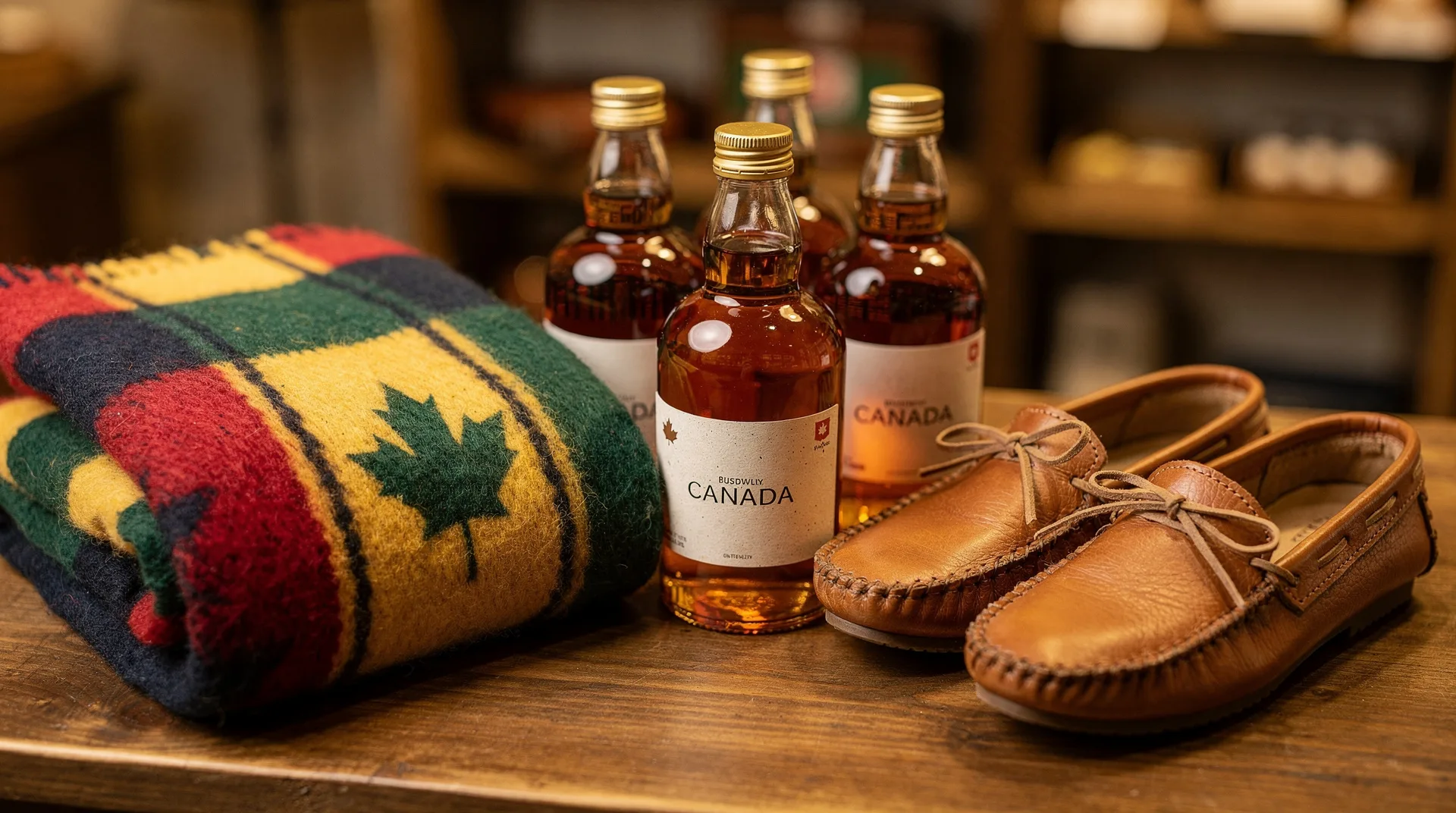
Best souvenirs to bring home from Canada
| At a glance | |
|---|---|
| Where | Farmers’ markets, Indigenous-owned galleries and craft shops, brand flagship stores in major cities |
| Cost | From a few CAD dollars (maple candy, dulse) to CAD 1,000+ (Canada Goose parkas, gallery-level Indigenous art) |
| Time needed | An hour at a market; a half-day if you want to properly browse galleries in Vancouver or Montreal |
| Getting there | Best souvenir shopping is concentrated in major cities, not airports |
| Best time | Any season, though sugar shack season (roughly March-April) is best for buying maple syrup directly from producers |
The souvenir problem is universal: you’ve had a genuinely good trip and you want to bring something home that reflects that, but the airport shops and the tourist-district stores are full of things that feel like they were manufactured in bulk somewhere far from the place they represent. Canada has this problem in some degree — there are a lot of maple leaf-branded items that have no meaningful connection to the country.
But Canada also has a strong tradition of genuinely good things to buy: quality outdoor gear manufactured here, artisanal food products that don’t travel without proper customs consideration, Indigenous-made art and craft at various price points, and regional specialties that vary significantly across the country’s enormous breadth.
This is a guide to buying well rather than buying a lot.
Maple syrup: buying it properly
The global market for maple syrup is dominated by Quebec, which produces about 70% of the world’s supply. Maple syrup is the canonical Canadian souvenir, and it’s a legitimate one — the real stuff, bought at the right grade for the right purpose, is genuinely different from the flavoured corn syrups sold in maple-leaf bottles in airports everywhere.
The grading system changed in 2015 and is now international. All maple syrup is Grade A, divided into four colour classes:
- Golden, delicate taste — the earliest spring sap, very light, excellent on pancakes or yogurt
- Amber, rich taste — mid-season, the most versatile, the classic pancake syrup
- Dark, robust taste — later season, stronger flavour, good for baking and cooking
- Very dark, strong taste — end of season, intense, best for cooking rather than eating raw
Buy from a sucrerie (sugar shack) directly if you’re in Quebec, or from producers at farmers’ markets. The Atwater Market in Montreal and the Jean-Talon Market in Montreal’s Mile End neighbourhood both have excellent maple producers. In smaller containers, maple syrup can be carried in checked luggage internationally; check your destination country’s customs rules for agricultural products.
Maple butter (maple syrup whipped to a spreadable consistency) and maple candy (hardened syrup formed into moulds, often leaf-shaped) are good complementary buys — maple butter especially is difficult to find outside Canada and keeps well. To see a sugar shack in action, you can browse guided food tours in Canada.
Indigenous art: the most meaningful purchase
Buying Indigenous-made art and craft from Indigenous artists and businesses is the most culturally meaningful souvenir purchase you can make in Canada — and it requires some care to do properly, since the market includes a significant amount of “Indigenous-inspired” or “Indigenous-style” work made by non-Indigenous manufacturers.
Look for work that identifies the specific nation, artist name, and ideally includes documentation of provenance. Reputable shops include galleries and co-operatives operated by Indigenous communities directly, and in major cities there are established galleries that represent Indigenous artists authentically.
West Coast Indigenous art (Haida, Musqueam, Squamish, Tsimshian, and others) is particularly well developed: prints, carvings, jewellery, and textiles that draw on a visual tradition with deep roots. Vancouver has several excellent galleries — the Bill Reid Gallery of Northwest Coast Art is a good place to educate yourself on the traditions before buying.
The Inuit art market has a longer commercial history and established authentication systems. Inuit sculpture in soapstone and whalebone, and Inuit prints from Cape Dorset (Kinngait Studios), are internationally recognised art forms. Prices range from accessible to gallery-level; authenticated pieces include documentation.
In the prairies and eastern Canada, beadwork, birchbark products, and quillwork represent distinct traditions. The Truth and Reconciliation Commission has emphasised the economic importance of supporting Indigenous businesses directly — this is an area where your souvenir purchase has genuine resonance.
Canadian outdoor gear
Canada has a legitimate claim to outdoor gear excellence — the climate has produced a market for serious cold-weather equipment and the country has several brands worth buying if you’re equipped for carrying clothing and gear home.
Canada Goose is the internationally famous one — the down-filled parkas are genuinely excellent cold-weather gear, not just a luxury logo item. They are expensive (CAD $1,000+ for main line parkas) but can be found at the company’s own stores in Toronto, Vancouver, and other cities. If you’re going to buy one, buying it in Canada is the obvious choice.
Arc’teryx is the Vancouver-based technical outerwear brand that has become the benchmark for backcountry and serious outdoor gear globally. Gore-Tex shells, down jackets, and climbing harnesses made to standards that few competitors match. Prices are high but the products justify them; the Vancouver flagship and stores in major Canadian cities carry the full range.
Roots Canada is less technical but deeply Canadian — the casual and heritage wear brand founded in 1973 has a loyal following for its sweatshirts, leather goods, and cabin-inspired aesthetic. More accessible price points than Arc’teryx; widely available across Canada.
Regional food specialties
Canada’s regional food cultures produce things worth carrying home carefully:
BC smoked salmon: Pacific salmon hot-smoked or cold-smoked by small producers in Vancouver, Victoria, and coastal BC communities. Vacuum-packed and shelf-stable for some time. Indigenous-operated smokehouses often produce the best quality. Check customs rules for your home country — salmon is often restricted as an agricultural import.
Prince Edward Island dulse: Dried seaweed harvested from the Bay of Fundy, eaten as a snack or used as a seasoning. Umami-rich, unusual, lightweight, and genuinely specific to the region. Non-perishable and customs-compliant.
Ice wine: Canada is the world’s largest producer of ice wine — wine made from grapes frozen on the vine, producing intensely sweet, concentrated nectar. Ontario’s Niagara Peninsula and BC’s Okanagan Valley are the main producing regions. Ice wine is expensive (small yields from frozen grapes) but unique; half-bottles are the standard souvenir size. If you’d like to taste before buying, there are Canada wine tasting tours to compare.
Nanaimo bars: A no-bake dessert from Nanaimo, BC — a chocolate-coconut base layer, custard middle, and chocolate top. Recipes are widely shared and you can make them at home, but the impulse to buy a box is understandable. They do not survive warm climates without refrigeration.
Books about Canada
A book written by a Canadian author, particularly one set in or about the specific place you visited, is a souvenir that performs long after the trip. Canada has an excellent literary tradition: Alice Munro (southern Ontario small towns), Margaret Atwood (Toronto and beyond), Michael Ondaatje (Montreal and Sri Lanka), Farley Mowat (Canadian wilderness), Robert Kroetsch (the prairies), and a hundred others.
Independent bookshops in major cities carry strong Canadian literature sections. Librairie Drawn & Quarterly in Montreal and Munro’s Books in Victoria are two of Canada’s best. Supporting independent booksellers rather than airport chain shops means the purchase goes somewhere meaningful.
Where to buy, by category
| Category | Best city | What to look for |
|---|---|---|
| Maple syrup, maple butter | Quebec City or Montreal sugar shacks | Grade A colour class matched to your use; buy direct from a producer where possible |
| Indigenous art (West Coast) | Vancouver | Named artist, specific nation, provenance documentation |
| Indigenous art (Inuit) | Toronto galleries, or direct from Cape Dorset co-operatives | Authentication paperwork included with the piece |
| Technical outerwear | Vancouver (Arc’teryx flagship) | Full range and guaranteed authenticity versus resale marketplaces |
| Ice wine | Niagara Peninsula wineries | VQA certification on the label |
| Regional food (dulse, smoked salmon) | Atlantic Canada, coastal BC | Vacuum-sealed, shelf-stable packaging for travel |
If your trip includes the Rockies rather than the cities covered above, don’t expect the same depth of shopping — Banff townsite has some good outdoor gear stores but is not a strong souvenir destination compared with Vancouver or Montreal.
Packing and shipping souvenirs home
Fragile items — Inuit prints, ceramics, glasswork — travel best rolled or padded in checked luggage rather than trusted to carry-on overhead bins. For bulkier purchases like a Canada Goose parka or multiple bottles of ice wine, some travellers find it cheaper to ship home via a courier than to pay excess baggage fees, particularly on a return flight that’s already near the weight limit. Always declare agricultural products (maple syrup, smoked salmon, dulse) honestly at your home country’s customs — undeclared items risk confiscation and a fine, while declared items are usually processed without issue.
What to avoid
Mass-produced “Canadian” merchandise made offshore: the lumberjack-print flannels, the stuffed moose, the maple-leaf-branded everything in airport shops and Niagara Falls souvenir stores. Not because all of it is terrible, but because it doesn’t reflect Canada and it doesn’t support Canadian makers.
Also worth avoiding: buying “Indigenous art” from shops that can’t identify the specific artist and nation. The difference between authentic Indigenous work and mass-produced “Indian style” goods is real and matters economically and culturally.
Practical shopping notes
Customs: Canada has strict agricultural import rules going out. Maple syrup is generally fine; fresh produce, meat, and some plant products are not. Research your home country’s import rules before buying perishable or agricultural products.
GST/HST rebate: International visitors are no longer eligible for the GST/HST rebate on purchases (the program ended in 2007). Prices you see are what you pay.
Currency: Canada uses the Canadian dollar, which has historically traded at a discount to the US dollar and euro, making purchases more affordable for many international visitors. Check the current rate.
Best shopping cities: Montreal for design and fashion; Vancouver for outdoor gear and Pacific Northwest art; Quebec City for heritage crafts and local food; Toronto for the widest range; Victoria and Charlottetown for smaller, more curated shopping experiences.
Final thoughts
The best Canadian souvenir is the one that still means something six months after you get home — that sits on a shelf or in a kitchen and occasionally makes you remember why you went. The maple syrup you use every Sunday morning, the print that hangs in the hallway, the sweater that works on actual cold days: these are worth more than a shelf of decorative maple leaves.
Buy less, buy better, and if in doubt, buy Canadian-made.
Frequently asked questions about Best souvenirs to bring home from Canada
Can I bring maple syrup home on an airplane?
Yes, with some limitations. In your carry-on, maple syrup is subject to the 100ml liquid rule if you’re transiting through a security checkpoint after purchase (buy it airside, or check it). In checked luggage, full-size bottles are generally fine. Your destination country’s agricultural import rules may restrict it — check before buying large quantities.
Where is the best place to buy authentic Indigenous art in Canada?
In Vancouver, the Bill Reid Gallery and Lattimer Gallery are well-established. In Toronto, the Feheley Fine Arts gallery specialises in Inuit art. In the prairies, the Wanuskewin Heritage Park near Saskatoon has an excellent craft shop. Always ask for provenance documentation and the artist’s name and nation.
Is ice wine worth buying as a gift?
Yes, particularly for wine enthusiasts. Canadian ice wine is genuinely world-class and rarely available at this quality outside Canada. Buy from a Vintners Quality Alliance (VQA) certified winery for guaranteed authenticity. The Niagara Peninsula Wine Country is the most accessible wine region if you’re based in southern Ontario.
Are Canada Goose jackets cheaper in Canada?
Marginally, and without customs duties. The bigger advantage is access to the full range and the guarantee of authenticity — the counterfeit Canada Goose market is significant. If you’re buying a genuine parka, buying from an authorised Canadian retailer makes sense.
What small, lightweight souvenirs are worth carrying internationally?
Maple candy (lightweight, shelf-stable, genuine), a small Inuit print (rolled carefully, inexpensive, authentic), dulse seaweed, ice wine in a half-bottle, and a good Canadian book. All fit in checked luggage without significant weight or space penalties.
Can I buy authentic maple syrup outside Quebec?
Yes, though Quebec produces most of the world’s supply. Ontario and the Maritimes also have producers, and farmers’ markets in Toronto and elsewhere sell genuine small-batch syrup. The grading system is national, so the same colour classes apply wherever you buy.
Is it cheaper to buy souvenirs in Canadian cities or at the airport?
Cities, consistently. Airport shops charge a premium for convenience and stock mostly mass-produced items. A market in Montreal, Quebec City, or Vancouver offers better prices and far better quality for maple products, Indigenous art, and regional food.