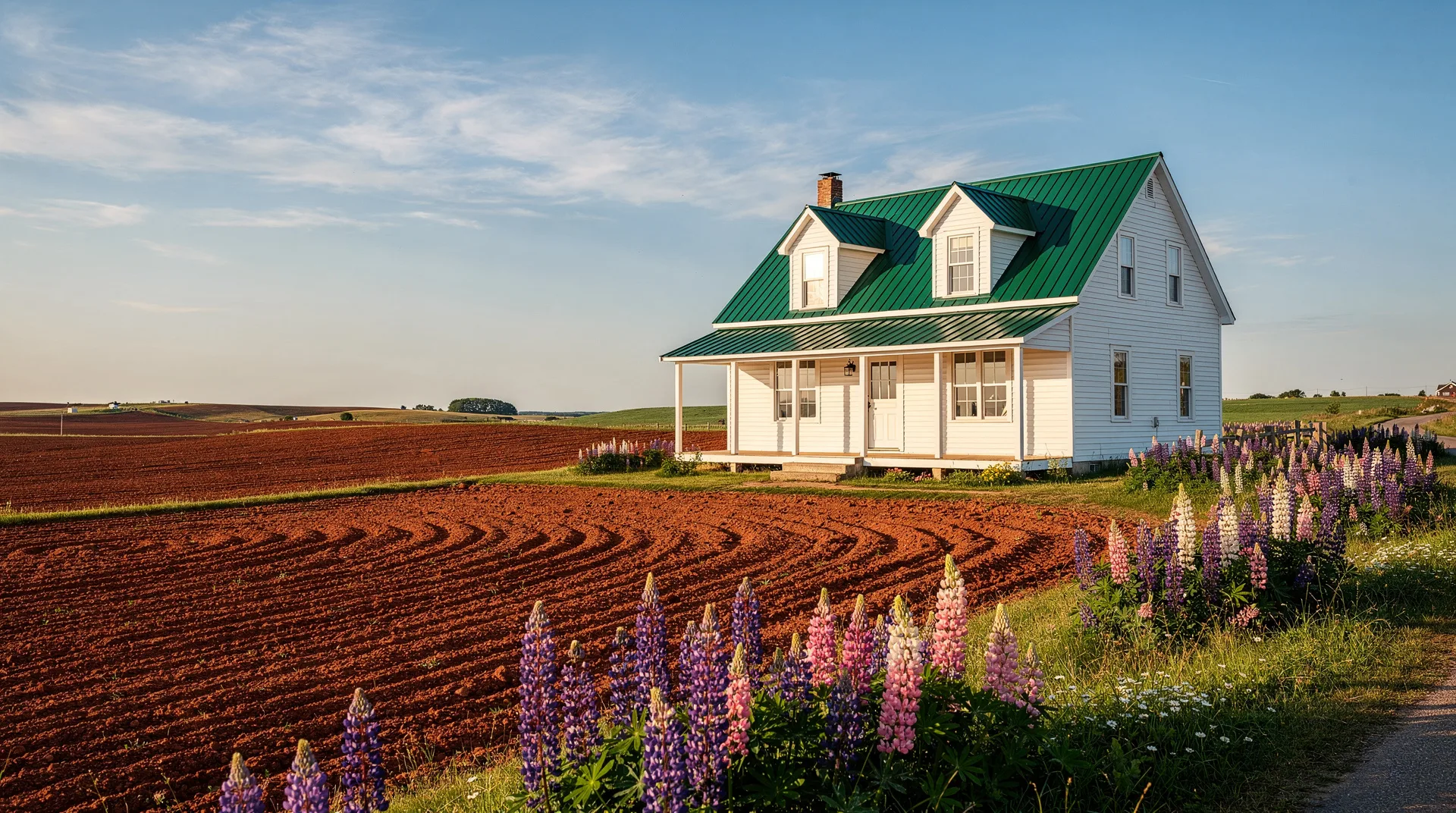
The Anne of Green Gables trail (PEI)
There’s a particular kind of pilgrimage that literary travellers make — arriving at the physical location of a story that shaped them, looking at an actual farmhouse or coastline and understanding, suddenly, that the geography was real all along. Prince Edward Island does this better than almost anywhere in Canada. The red soil, the green fields rolling to the sea, the absurdly photogenic farmhouses: it’s all exactly as described, still recognisable more than a century after Lucy Maud Montgomery put it on the page.
Anne of Green Gables was published in 1908. It has never gone out of print. It has sold more than fifty million copies globally and inspired a Japanese literary obsession so intense that tour groups from Tokyo arrive in Cavendish every summer specifically to stand in the Anne universe. PEI has leaned into this identity fully, and the result is a small island that has managed to turn one fictional red-haired orphan into a year-round cultural economy.
| At a glance | |
|---|---|
| Where | Cavendish and Charlottetown, Prince Edward Island |
| Cost | Parks Canada entry fee at Green Gables applies; Discovery Pass worth it if visiting multiple parks |
| Time needed | 2-3 days for the main sites; 4-5 days for a full island circuit |
| Getting there | Confederation Bridge by car, or Charlottetown Airport (direct flights from Toronto, Montreal, Ottawa, Halifax) |
| Best time | June or September for good weather with thinner crowds; July-August is peak season |
This is a guide to doing the Anne trail properly — not just the obligatory farmhouse stop, but the broader literary and landscape experience that makes PEI one of Atlantic Canada’s most memorable destinations.
Where the story begins: Green Gables heritage place
The farmhouse that inspired the novel is the obvious starting point. Located in PEI National Park near Cavendish, the Green Gables heritage site is a Parks Canada property that has been meticulously restored to reflect the period described in the novel. The rooms are furnished as they appear in the book — Anne’s east gable bedroom, Matthew’s room, the kitchen where Marilla ran her orderly household.
What surprises most visitors is how genuinely attractive the property is. Green Gables isn’t a theme park reconstruction — it’s a real nineteenth-century farmhouse that Montgomery knew as a child (it belonged to cousins of her family) and which she used as the physical model for the Cuthbert home. The surrounding grounds include the Haunted Wood trail and Lover’s Lane, the forest paths that appear repeatedly in the novels.
The heritage site is open May to October, with peak interpretation programming running in summer. Parks Canada entry fees apply; the annual Discovery Pass is worth buying if you’re visiting multiple parks. Guided tours of PEI’s Anne sites are available and worth considering for the depth of context they provide — a good guide turns a heritage site visit into something approaching a literary experience.
The Cavendish area: where Montgomery lived and wrote
Anne of Green Gables was written not in the Green Gables farmhouse but in Lucy Maud Montgomery’s actual home — a modest house in Cavendish where she lived with her grandparents. The site of that original home is marked and accessible, though the building no longer stands. What does remain is a sense of the community she inhabited: a small, tightly knit rural settlement where her acute observations of human character were formed.
The Cavendish cemetery holds Montgomery’s grave, which receives a steady stream of literary pilgrims year-round. The inscription on her stone is taken from her journals. Nearby, the Cavendish United Church — rebuilt after the original burned — stands on the site she would have attended weekly.
The L.M. Montgomery Institute at the University of PEI in Charlottetown maintains an excellent scholarly collection and runs periodic festivals and conferences, particularly the biennial L.M. Montgomery Institute conference that draws researchers from around the world.
Charlottetown: the provincial capital and cultural centre
The capital of PEI earns its place on the Anne trail not through direct literary connection but through the theatrical tradition it has built around the novels. The Confederation Centre of the Arts has been staging the Anne of Green Gables musical every summer since 1965 — the world’s longest-running annual musical theatre production. The production is earnest, well-crafted, and surprisingly moving, particularly if you come to it with any familiarity with the books.
Charlottetown itself is worth a day regardless of the Anne itinerary. As the birthplace of Canadian Confederation (the 1864 Charlottetown Conference produced the framework for Canada’s 1867 founding), it has genuine historical weight. Province House, where the conference took place, is a Parks Canada National Historic Site. The Victoria Row restaurant district is excellent by any standard, not just provincial — PEI’s lobster and seafood are the best argument for eating locally that Atlantic Canada makes.
The Confederation Trail runs the length of the island and is excellent for cycling; the Charlottetown section is paved and connects to the broader trail network.
Beyond Cavendish: lesser-known Montgomery country
Most Anne tourists cluster around Cavendish and Charlottetown and miss the quieter parts of the island where Montgomery’s sensibility was equally present. Prince County in the west and Kings County in the east have a different character — more agricultural, less touristed, with the same red-soil and ocean-view landscape that defines PEI visually.
Park Corner, about 20 km west of Cavendish, holds the Anne of Green Gables Museum at Silver Bush — the home of Montgomery’s cousins, the Campbell family, where she spent happy childhood summers and which inspired elements of the novels. The lake beside the house is the “Lake of Shining Waters” described in the book. The property is still owned by a descendant of the original family, which gives it an authenticity and personal warmth that institutional sites sometimes lack.
The New London area holds Montgomery’s birthplace house, a small heritage building that has been preserved and interpreted. Her mother died when Montgomery was young, and she was raised by grandparents, but the birthplace represents the beginning of the Montgomery story.
The physical landscape as co-author
One of the things the Anne books do brilliantly is make landscape feel like emotional weather — the quality of light on the Gulf Shore, the colour of the fields in different seasons, the specific red of PEI’s iron-rich soil. Experiencing the actual landscape while the novels are fresh in memory is one of those rare cases where reading enhances travel and travel enhances reading simultaneously.
The Gulf Shore Parkway that runs through the national park offers the specific coastal experience Montgomery wrote about. The beaches are striking — red sand in places, white in others, backed by dunes and the kind of clear shallow water that turns improbably blue on sunny days. The red sandstone cliffs are one of PEI’s defining visual features, nowhere better seen than from the beach looking back toward the land.
Cycling the parkway at dawn, before the summer crowds arrive, is one of the more peaceful experiences in Atlantic Canada — long light on red cliffs, the smell of the sea, the sound of birds in the marram grass. It’s the landscape Anne would have been running through barefoot, dramatic declarations forming in her head about the precise quality of the morning.
When to go: seasons on the island
PEI’s tourism season is concentrated in July and August, when the weather is reliably warm and all attractions are fully operational. The Anne sites are at their busiest then, the musical runs nightly, and the island’s famous lobster suppers are in full swing. Families with school-age children tend to concentrate in these months.
June and September are the sweet spots for most travellers. The weather is still good, the crowds are thinner, accommodation is more available and less expensive, and the island has a more settled, local character. The Cavendish area in particular is transformed by the absence of peak-season traffic — you can walk the Haunted Wood trail without encountering tour groups.
October is worth knowing about: the fall colours on PEI are less dramatic than Quebec or Ontario, but the island’s agricultural landscape takes on warm amber tones and the coastline has a moody, slightly melancholy quality that suits the more autumnal parts of Montgomery’s writing.
Winter is quiet — many attractions close, and the ferry from Borden-Carleton to the mainland can be challenging in rough weather. The Confederation Bridge (13 km, opened 1997) is open year-round and is an extraordinary piece of engineering to drive across, the longest bridge over ice-covered waters in the world.
Building it into a wider Atlantic Canada trip
PEI rarely stands alone on an Atlantic Canada itinerary, and it shouldn’t — the island pairs naturally with Nova Scotia via the Wood Islands ferry or a loop back through New Brunswick over the Confederation Bridge. Travellers combining the Anne trail with a broader regional trip often route through Halifax for the flight connections and add a few days on the Cabot Trail in Cape Breton, which shares PEI’s coastal drama without the literary crowds. For a shorter, PEI-only visit, the PEI 5-day itinerary is built specifically around this pacing — Anne sites, Charlottetown, and enough slack for a lobster supper night without rushing.
What the Anne sites don’t tell you
The Anne of Green Gables tourism economy is, on reflection, a slightly odd thing to witness in person — a farmhouse that never held the fictional family, staffed by costumed interpreters, drawing tour buses of visitors who grew up with a Japanese-dubbed anime adaptation as much as the original novel. None of that undermines the experience; if anything it deepens it, because you’re watching a place absorb and metabolize its own myth in real time.
The most honest way to enjoy it is to treat the heritage-site parts as theatre and the landscape parts — the Gulf Shore Parkway, the red cliffs, the actual light over the fields — as the real payload. Montgomery’s writing holds up because the setting does; the museum exhibits are secondary to that.
Practical notes for planning
Getting to PEI: The Confederation Bridge from New Brunswick is the most straightforward arrival for road travellers. The Wood Islands ferry from Pictou, Nova Scotia runs seasonally and is a pleasant 75-minute crossing. Charlottetown Airport has direct flights from Toronto, Montreal, Ottawa, and Halifax.
How long to spend: Two to three days covers the main Anne sites and Charlottetown. Four to five days allows a more complete island circuit, including Prince and Kings counties and the quieter eastern end.
Accommodation: Charlottetown has the best range; Cavendish has concentrated tourist accommodation close to the national park. Cottage rentals are excellent value for families and groups.
Lobster suppers: New Glasgow Lobster Suppers is the most famous; there are several others around the island. This is mandatory. PEI lobster is not improved by saving it for somewhere else.
Final thoughts
PEI punches well above its size. It’s Canada’s smallest province, but it has managed to build an identity around a single fictional character so effectively that it draws literary pilgrims from fifty countries. The Anne trail is genuinely worth following — not because the sites are spectacular in a conventional sense, but because the island’s actual landscape justifies the novels’ emotional claims about it.
The red soil and the evening light over the Gulf Shore and the absurd specific blue of Cavendish Beach on a clear July morning: Montgomery didn’t exaggerate any of it. If anything, she understated.
Frequently asked questions about The Anne of Green Gables trail (PEI)
Is Green Gables the real house from the novel?
Green Gables was a real farmhouse belonging to cousins of Montgomery’s family. She knew the property well as a child and used it as the model for the Cuthbert home in the novel. It is not, in the fiction, the same house — but the physical correspondence between the real building and the described one is close enough that it reads as the authentic location.
Do I need to have read the books to enjoy the sites?
The experience is significantly richer with some familiarity with the novels, but the landscape and heritage sites are worthwhile on their own terms even for first-time readers. The musical in Charlottetown is a good way to get the story if you haven’t read the books — it covers the main narrative of the first novel effectively.
What is the best way to see PEI without a car?
PEI is difficult without a car. Charlottetown is walkable, but the Cavendish sites are 40 km away and public transport is limited. Bike rentals are available in Charlottetown, and the Confederation Trail is excellent for cycling, but distances between main attractions make a car the practical option for most visitors. Tour operators run day trips from Charlottetown that cover the main Anne sites, and you can compare Prince Edward Island day tours before you travel.
How much time should I spend at Green Gables specifically?
Two to three hours is comfortable for the heritage house, the Haunted Wood trail, and Lover’s Lane. If you add the adjacent golf course and beach areas, half a day is reasonable. The Parks Canada interpretation is good; allocate more time if you’re with children who know the books.
Is PEI worth visiting outside of Anne-related tourism?
Completely. The cycling, beaches, seafood, and general pastoral beauty of the island are excellent travel reasons independent of any literary connection. PEI has developed a food tourism reputation — oysters, lobster, potato-based everything — that would justify a visit even if Montgomery had never written a word.
Can I combine the Anne trail with the rest of Atlantic Canada in one trip?
Yes, and most visitors do. PEI connects to Nova Scotia via the seasonal Wood Islands ferry and to New Brunswick via the Confederation Bridge, making it straightforward to combine with the Cabot Trail or a Halifax-based trip. Allow at least 2-3 days on PEI itself within that broader loop.
Is the Anne of Green Gables musical suitable for young children?
Generally yes — it’s a family-friendly stage production and a highlight of many PEI trips with kids, though very young children may find the roughly two-hour runtime long. Families travelling with children often build a full day around it in Charlottetown, pairing it with Province House and the Victoria Row restaurant district.